Learning Content
This module helps future Senior Cultural Ambassadors design, adapt and facilitate simple five-senses-based activities in museums, galleries and other cultural spaces. It shows how sensory prompts, open-ended questions and TimeSlips-inspired facilitation can support curiosity, close observation, imagination, participation and shared cultural engagement without requiring formal art knowledge.
The module is practical and designed for adults aged 55+, adult educators working with older learners, and museum or gallery educators who want to make cultural learning more active, welcoming, inclusive and meaningful
● Understand how sensory engagement can make museum and gallery visits more meaningful and participatory for older learners.
● Recognise how sight, sound, touch, smell and taste-related associations can be used safely and respectfully in cultural learning.
● Learn how to select and prepare simple sensory prompts connected with artworks, objects and cultural spaces.
● Practise creating and using open-ended sensory questions that incorporate selected TimeSlips-inspired principles such as imagination, acceptance and failure-free participation.
● Design and adapt short five-senses-based activities that Senior Cultural Ambassadors can support or co-facilitate.
Knowledge-based outcomes | Practical skills |
● Learners can explain the difference between passive observation and sensory engagement and its value for older learners. | ● Learners can select and prepare suitable sensory prompts and materials for an artwork, object or cultural space. |
● Learners can describe how the five senses may be used directly, indirectly or imaginatively in cultural activities.
| ● Learners can create open-ended sensory questions that incorporate selected TimeSlips-inspired principles. |
● Learners can explain how open-ended questions, imagination, acceptance and failure-free participation can reduce pressure and encourage contribution. | ● Learners can design and adapt a short five-senses-based activity, including different ways to participate and a small shared result. |
● Learners can recognise safety, comfort, personal boundaries and accessibility considerations in sensory engagement activities. | ● Learners can respond to participants in a supportive, non-judgemental way and collect simple feedback after the activity. |
· Respect for different responses: participants may notice, imagine and connect with cultural objects in different ways.
· Invitation without pressure: participants may speak, write, point, choose a card, listen or decide not to respond.
· Curiosity instead of expertise: sensory engagement values noticing and imagination rather than correct art-historical knowledge.
· Acceptance and supportive facilitation: contributions are acknowledged without correction, while different ideas are allowed to exist together.
· Adaptability and careful boundaries: activities should be adjusted to participants’ comfort, abilities and energy, while remaining cultural and educational rather than therapeutic or diagnostic.
Museums and galleries are often experienced mainly through looking. Visitors are invited to observe paintings, sculptures, photographs, historical objects, architecture or exhibition spaces. For some seniors, this can be enjoyable. For others, it can feel passive, tiring or intimidating, especially if they believe they need expert knowledge to understand what they see.
Sensory engagement offers another way in. It invites participants to notice colours, shapes, textures, sounds, spaces, memories, smells, tastes and bodily sensations connected with the cultural experience. The goal is not to touch original museum objects or to analyse art formally. The goal is to create more routes for attention, connection and participation.
The five senses can be used directly or indirectly. For example, participants may look at the texture of a painted surface, listen to the soundscape of a gallery, hold a safe handling object, smell a small scent card connected with a historical period, or imagine the taste of a meal shown in a painting. These small sensory openings can help seniors feel that they are allowed to respond personally and creatively.
Multisensory museum practices may combine visual observation with sound, smell, safe handling materials and imaginative sensory associations (Ucar, 2015; D’Andrea et al., 2022).
This module also incorporates selected TimeSlips-inspired principles, particularly open-ended invitation, imagination, acceptance and failure-free participation. Within museum and gallery learning, these principles provide a supportive frame for sensory exploration and encourage participants to respond without pressure to recall facts or provide a single correct interpretation.
This approach is informed by TimeSlips practices that replace pressure to remember with opportunities to imagine and respond to open-ended prompts (TimeSlips Creative Storytelling, 2019).
Future Cultural Ambassadors can use these tools to support peers during visits, help groups slow down and notice more, invite simple responses, and co-create short cultural activities that feel friendly, respectful and accessible.
The five senses provide the entry point. Open-ended, TimeSlips-inspired facilitation provides the participation frame. Together, they help seniors move from “I do not know enough” to “I can notice, imagine and contribute”.
This module is about... | This module is not about... |
Simple sensory engagement in cultural spaces. | Formal art history lectures. |
Open-ended questions and personal responses. | Testing whether answers are correct. |
Five-senses-based prompts and activities. | Full museum accessibility audits. |
TimeSlips-inspired principles for failure-free participation. | Official TimeSlips certification or therapy. |
Practical activities for Senior Cultural Ambassadors. | Clinical reminiscence therapy or psychological counselling. |
Observation is important in museums and galleries, but observation is only one part of experience. A visitor may look at an object, but also sense the space around it, hear the sounds of the room, imagine the texture of the material, remember a similar object from home, or feel a mood created by light, colour and scale.
For senior learners, sensory engagement can be especially useful because it allows participation without requiring specialist vocabulary. A participant can say, “This colour feels warm,” “The room sounds calm,” or “This object reminds me of my grandmother’s kitchen.” These responses are valid cultural learning responses, even when they are not formal art analysis.
Research on museum programmes involving older adults indicates that accessible, creative and object-based activities can support engagement, learning, social interaction and psychological wellbeing (Todd et al., 2017; Thomson et al., 2018).
Observation-focused visit | Sensory engagement visit |
The guide or educator explains information. | The group is invited to notice, sense and respond. |
Participants may feel they need correct knowledge. | Participants can contribute through experience and perception. |
The main question is: “What does this artwork mean?” | The main question is: “What do you notice, feel, hear, imagine or associate?” |
Visual attention dominates. | Several senses can support attention and memory. |
Some participants might remain silent. | More participants can join through simple prompts. |
Research on object handling also suggests that combining visual, tactile and verbal engagement may support learning, wellbeing and social inclusion among older adults <…> (D’Andrea et al., 2022).
Cultural Ambassadors are not expected to replace museum educators. Their value is different. They can help peers feel more comfortable, slow down the visit, notice details, and invite gentle participation. These principles correspond with practice guidance developed through the Museums on Prescription project for working with older people in museums (Veall et al., 2017).
A sensory approach gives Ambassadors practical tools that are easy to learn and easy to adapt.
• They can ask simple sensory questions while standing near an object.
• They can prepare small handling materials or prompt cards with museum staff.
• They can support quieter participants by offering several ways to respond.
• They can help the group connect the exhibition with lived experience without forcing personal disclosure.
Senior-friendly principle
Start with noticing, not explaining. A simple sensory observation can open the door to confidence, conversation and curiosity.
Mini example
Instead of starting with “This painting belongs to the Impressionist period”, the facilitator may begin with: “What is the first colour your eyes notice?” or “If this picture had a sound, would it be quiet or loud?” After a few responses, factual information can be added in small portions.
This section presents five sensory access points and explains how they can be used safely and imaginatively in museums and galleries.
Each sense can offer a different way of connecting with an artwork, object or cultural space. An activity does not need to involve all five senses; one clear sensory focus is often enough.
Sense | Possible museum/gallery prompts
|
Sight | Colour, light, shadow, shape, scale, movement, detail, contrast, facial expression and composition.
|
Sound | The actual gallery soundscape, imagined sounds within an artwork, rhythm, silence, voices, music, sounds of work or making, and sounds from nature.
|
Touch | Approved handling objects, replicas, material samples, imagined textures, gestures, body posture and associations with warmth, coolness, weight or pressure.
|
Smell | Mild scent cards, herbs, wood, soap, fabric, seasonal scents and imagined smells connected with a scene, object or place.
|
Taste-related associations | Associations with meals, spices, traditional foods, celebrations, daily routines and imagined tastes connected with depicted food, colours or cultural objects. |
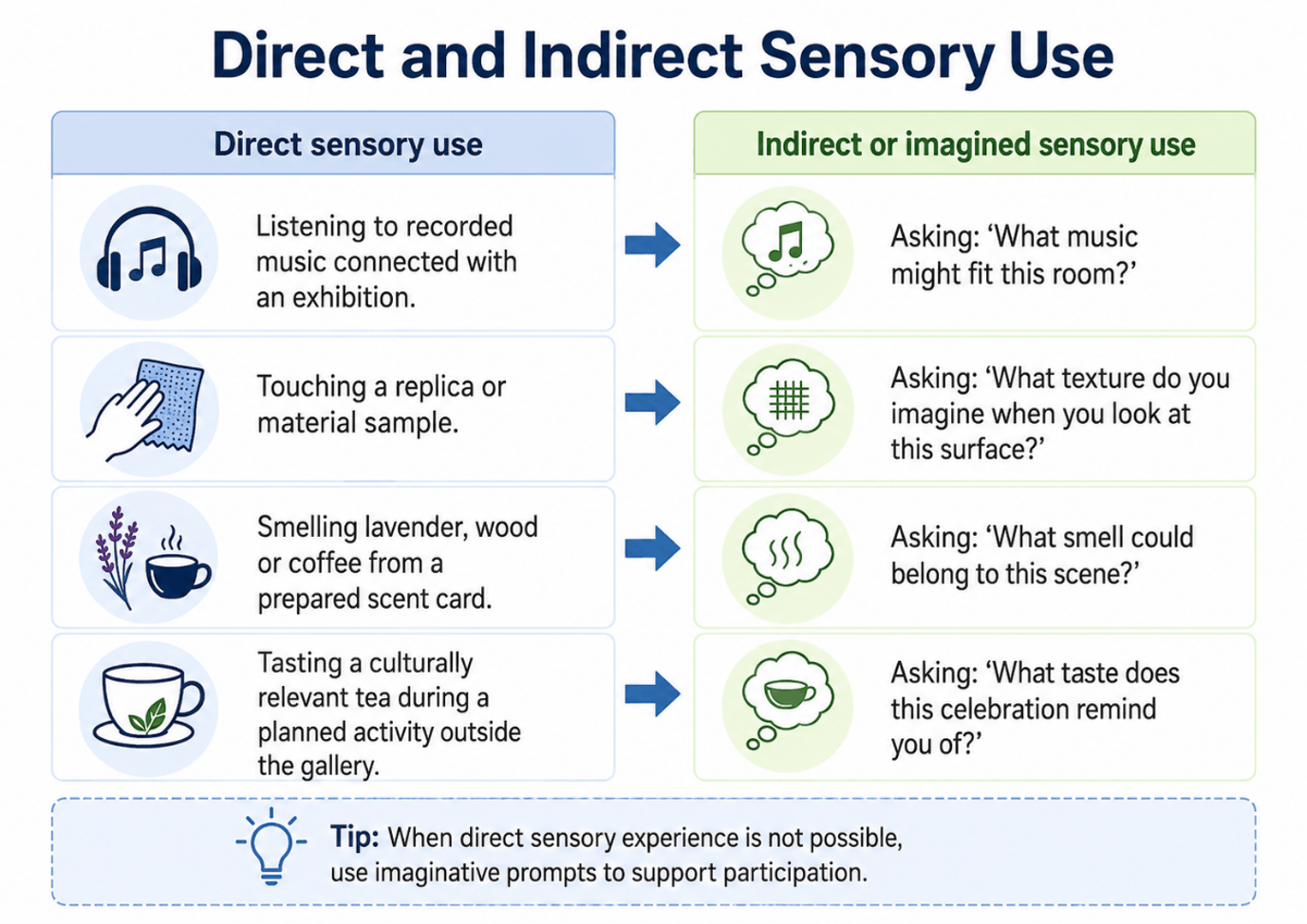
Sensory engagement does not always require participants to physically experience a sound, texture, smell or taste. In museums and galleries, some senses can be used directly, while others are explored through safe materials, associations or imagination. Understanding this difference helps Cultural Ambassadors choose prompts that are meaningful, practical and appropriate for the setting.
Museum-based multisensory practices demonstrate how replicas, sound, smell and other sensory materials can provide additional ways to engage with collections without touching original artworks (Ucar, 2015).
Figure 1.: Direct and Indirect Sensory Use
Sensory engagement should always respect the collection, the venue and participants’ personal boundaries.
· Never touch original artworks or collection objects unless museum staff explicitly permits it.
· Use approved replicas, handling objects or material samples when touch is included.
· Avoid strong scents and always allow participants to decline scent-based activities.
· Do not use food unless allergies, hygiene requirements and venue regulations have been considered.
· Keep sensory prompts simple. Too many stimuli at once may become tiring or confusing.
· Offer different ways to participate: participants may speak, point, write, choose a card or simply listen.
Sensory activities should always follow the collection-care and visitor-safety requirements of the museum or gallery in which they are used. Guidance on working with older museum participants also emphasises comfort, choice, clear communication and adaptable participation (Veall et al., 2017).
Practical tip
A small sensory kit can include fabric samples, wooden pieces, smooth stones, scent cards in closed envelopes, sound links on a phone, large-print prompt cards and clean wipes. It should be approved by the museum or gallery before use.
A sensory prompt is a small stimulus or question that helps participants notice and respond. It should be simple, respectful and connected with the artwork, object or space.
These principles reflect museum guidance that emphasises accessible, participant-centred activities connected with museum objects and collections (Veall et al., 2017).
Good prompts do not overwhelm the group. They open one clear route into experience.
Selection question | What to look for |
Is the prompt connected to the object or space? | The prompt should feel relevant, not random. For example, fabric samples may fit a textile exhibition. |
Is it safe and appropriate for the setting? | The prompt should not damage objects, create allergy risks or disturb other visitors. |
Is it simple? | Participants should understand what to do without long instructions. |
Is it respectful? | Avoid prompts that force painful memories, stereotypes or personal disclosure. |
Can it include different participants? | Consider hearing, vision, mobility, language level, confidence and cultural background. |
Can it be used in 5-10 minutes? / Can it fit into a real museum visit? | The prompt should be flexible enough to use briefly and shorten if the group becomes tired or the space becomes busy. |
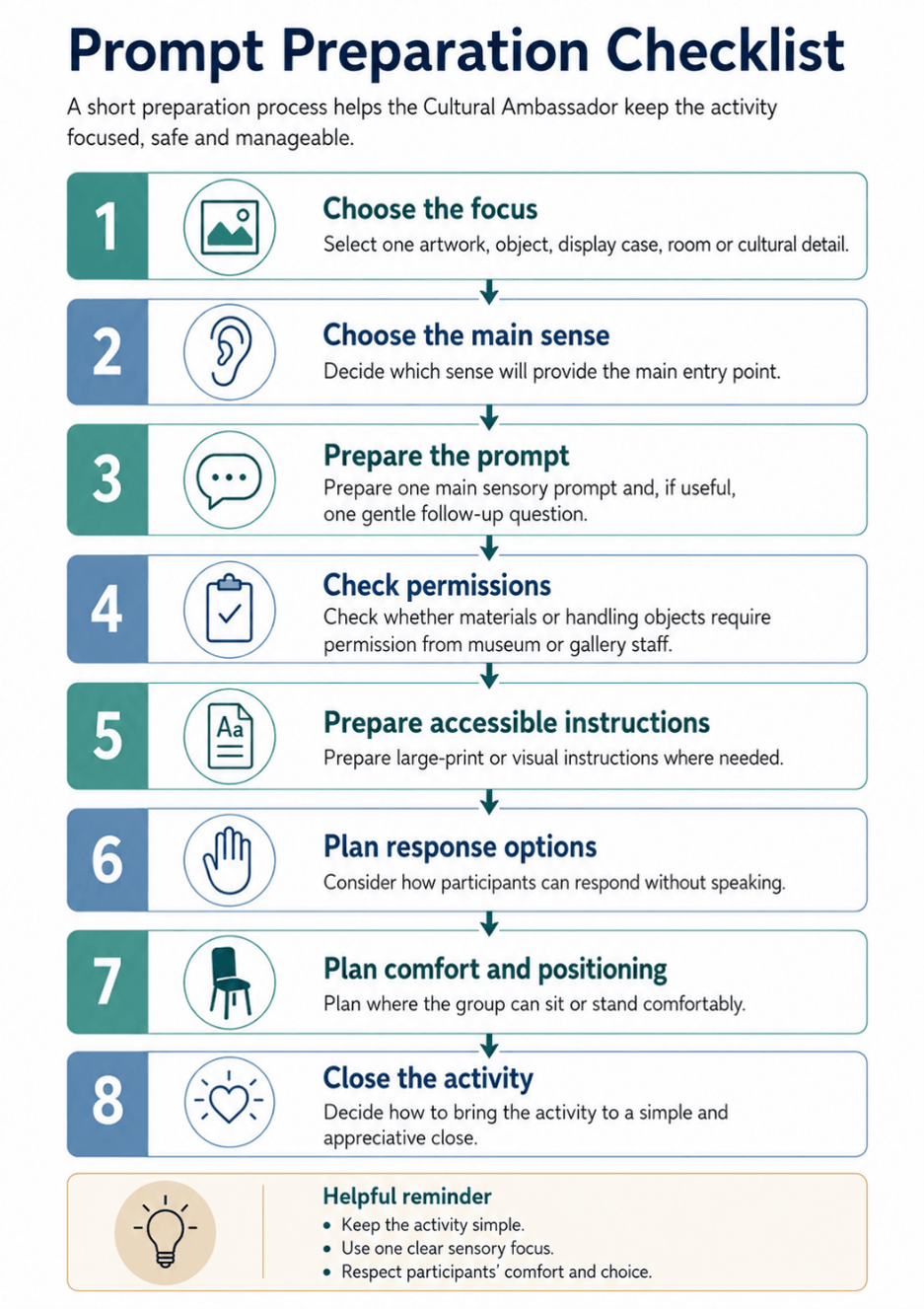
A short preparation process helps the Cultural Ambassador keep the activity focused, safe and manageable.
Figure 2: Prompt Preparation Checklist
The following examples show how sensory prompts can be connected with different types of cultural material. The wording may be adapted to the group and setting.
Cultural object / space | Prepared sensory prompt |
A landscape painting | Sight: “Find one colour that creates the atmosphere.” Sound: “What would you hear if you stepped inside this place?” |
A ceramic bowl | Touch: “Look at the surface. Would it feel smooth, rough, cool or warm?” |
A historical kitchen display | Smell: “Which smell could be present here: smoke, bread, herbs, soap, fruit?” |
A textile or costume | Touch: “Which fabric sample feels closest to what you imagine?” |
A gallery corridor or hall | Sound: “How does this space sound today? Is it echoing, calm, busy or silent?” |
A photograph of a celebration | Taste-related association: “What food or drink might belong to this moment?” |
Practical museum outreach examples demonstrate how replicas, textures, scents and other accessible materials can support sensory engagement with museum collections (Crawford, 2022).
Preparing for emotional safety
Sensory prompts may evoke personal memories or associations (D’Andrea et al., 2022). This can be positive, but it can also become sensitive. The Cultural Ambassador should not push for details. A person may simply say “This reminds me of home” and stop there. That is enough.
• Do not ask participants to explain private memories if they do not want to.
• Avoid questions such as “Why did this make you sad?”
• Use gentle alternatives: “Would you like to say more, or shall we move on?”
• Keep the group focused on cultural engagement, not therapy.
Boundary for Cultural Ambassadors A Cultural Ambassador can invite reflection, but should not analyse emotions, diagnose needs or provide therapy. The safest role is to listen, acknowledge and continue gently. |
Open-ended sensory questions invite participants to notice, imagine and contribute without needing factual knowledge or one correct answer. This reflects the TimeSlips emphasis on replacing the pressure to remember with the freedom to imagine (TimeSlips Creative Storytelling, 2019). They are especially useful for seniors who may feel uncertain about whether they “understand art” or know enough about museums.
A good open-ended question should be:
easy to understand;
connected with the artwork, object or space;
broad enough to allow different responses;
focused enough not to confuse participants;
answerable through observation, imagination or association;
possible to respond to through words, gestures, cards, writing or silence.
Closed or testing question | Open-ended sensory question
|
“What year was this object made?” | “What detail makes this object feel old, new or familiar?” |
“What is the style of this painting?” | “What colours or shapes catch your attention first?” |
“Who is the artist?” | “What might the artist have noticed with their eyes, hands or ears?” |
“What is this object used for?” | “How do you imagine this object would feel in your hand?” |
“Is this artwork happy or sad?” | “What mood do you sense in this artwork?” |
“Is this sculpture made of stone?” | “What material does this sculpture make you think of?” |
The question should not simply be broad. It should also invite sensory noticing or imagination.
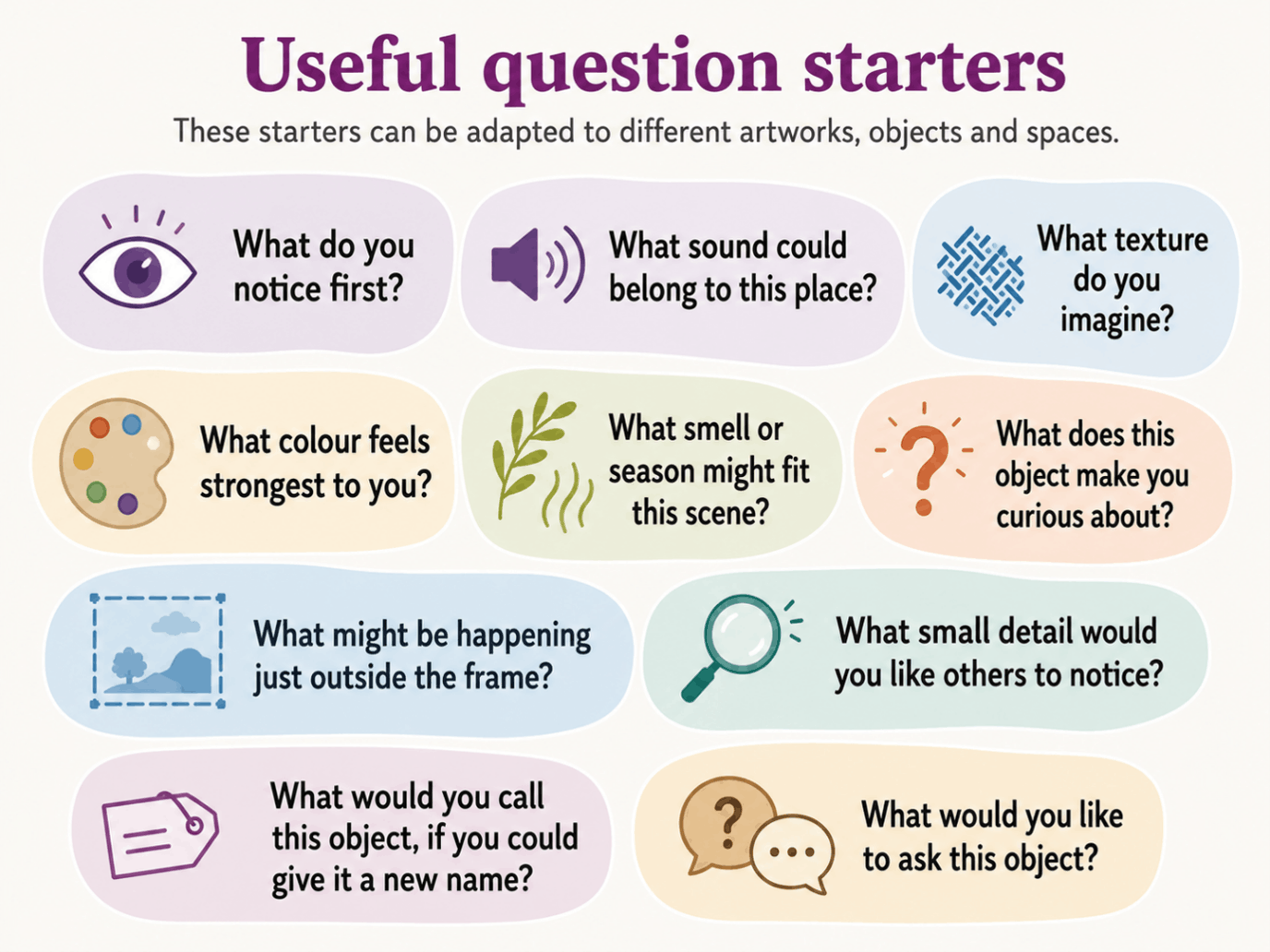
These starters can be adapted to different artworks, objects and spaces:
Figure 3: Useful Question Starters
The facilitator’s response is as important as the question. If the response sounds evaluative, participants may become silent. If the response is accepting, more people may feel safe to contribute (TimeSlips Creative Storytelling, 2019).
Helpful responses | Responses to avoid |
“Thank you. I will add that.” | “No, that is not what it means.” |
“That gives us another way to look.” | “Are you sure?” |
“Let us keep both ideas.” | “The correct answer is…” |
“You noticed something different.” | “You misunderstood the artwork.” |
“What else might belong here?” | “Only one interpretation is right.” |
“Would anyone like to build on that idea?” | “Try to remember the right answer.” |
“You may also point, choose a card or simply listen.” | “Everyone needs to answer.” |
Participation rule An open-ended question should lower pressure. If the question feels like a test, it is not the right question. |
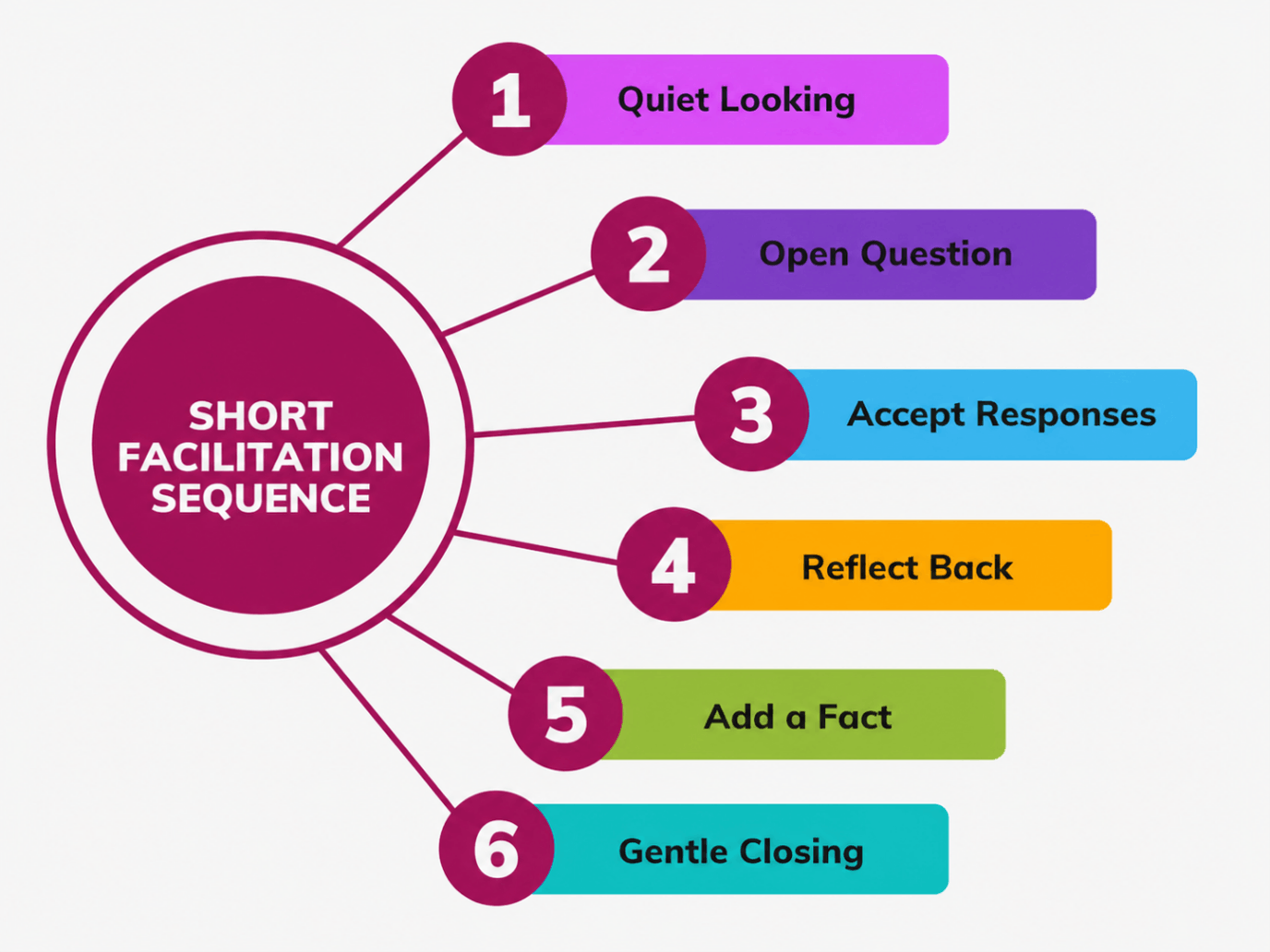
Figure 4 presents a simple sequence for facilitating a short sensory discussion, beginning with quiet observation and ending with an appreciative closing.
Open-ended sensory questions are an important starting point, but a failure-free activity involves more than asking a good question. It also depends on how participation is introduced, how contributions are received and how individual ideas are brought together into a small shared result.
In this module, selected TimeSlips-inspired principles are used to help Cultural Ambassadors create low-pressure sensory activities in which participants can notice, imagine and contribute without needing to recall facts or provide one correct interpretation.
TimeSlips is a creative engagement approach that places imagination, expression and participation before factual recall (TimeSlips Creative Storytelling, 2019). In this module, selected principles are incorporated into sensory activities for museums and galleries.
These principles include:
open-ended invitation;
imagination instead of memory testing;
acceptance of different responses;
several ways to participate;
building on participants’ contributions;
appreciation rather than evaluation.
Together, these principles help Cultural Ambassadors create low-pressure activities in which participants can notice, imagine and contribute without needing specialist knowledge or one correct answer.
Important clarification
This chapter incorporates selected principles associated with the TimeSlips approach and adapts them to short sensory engagement activities in museums and galleries. The activity structures and examples presented here are MUGArtS adaptations, not official TimeSlips session formats.
An open-ended question alone does not make an activity failure-free. The facilitator should also offer a gentle invitation, allow different ways to participate, acknowledge participants’ contributions and bring their ideas together in a small shared result. These principles are incorporated into the complete activity structure presented in Section 8.1.
In a TimeSlips-inspired activity, the facilitator does more than accept an answer and move on. When appropriate, they help participants develop or connect their ideas.
This is sometimes described through the principle of “yes, and…”. “Yes, and…” is identified by TimeSlips as a core principle for affirming contributions and supporting further creative engagement (TimeSlips Creative Storytelling, 2021).
The facilitator does not need to use these exact words. The principle means:
acknowledging the contribution;
keeping the idea present;
inviting another idea or detail.
Example
Participant: “I can hear a storm.”
Facilitator: “A storm. That gives the painting a powerful atmosphere. What other sound might be part of it?”
Another participant may add:
“A window moving in the wind.”
The facilitator may then ask:
“Would that sound feel close or far away?”
This helps the group build a shared sensory environment without deciding which answer is correct.
Useful ways to build on an idea include:
“What else could belong here?”
“Would that feel near or far away?”
“Could that sound be soft or strong?”
“Does anyone have an idea that could go with this?”
“Let us keep both possibilities.”
Not every response needs a follow-up question. Building on ideas should remain gentle and natural.
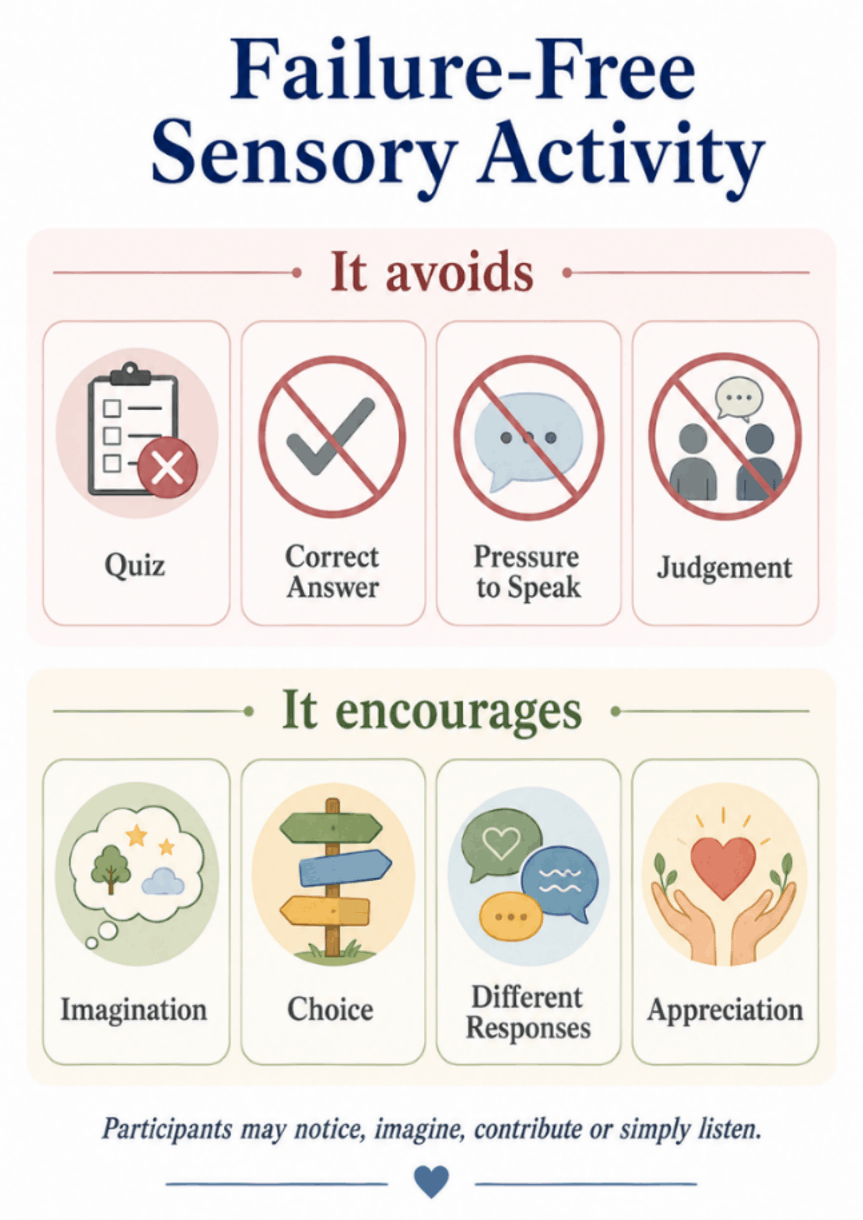
A failure-free sensory activity remains structured, but success does not depend on memory, specialist knowledge or verbal confidence. Its main principles are summarised in Figure 5.
Figure 5: Failure-free Sensory Activity
In addition:
the activity should not require names, dates or specialist terminology;
participants should always be able to pass without explaining why.
For a complete review before using an activity, refer to the Quality Checklist in Figure 7.
A Cultural Ambassador may invite participants to imagine sounds connected with a landscape painting by asking:
“If we stepped into this painting, what sound might we hear?”
Different responses – such as wind, water, birds, footsteps, voices or silence – are accepted and recorded without correction. The group may arrange the contributions into a simple sound map and create a shared title. This example demonstrates how an open-ended sensory question can lead to a failure-free shared result. A complete step-by-step version is provided in Activity 2: Soundtrack of an Artwork.
A good sensory engagement activity for Cultural Ambassadors should be short, clear and adaptable. It should work in a real museum or gallery visit where time, space, group energy and accessibility conditions may change.
A simple structure helps the Ambassador stay focused and makes the activity easier for participants to follow. The aim is not to include many tasks, but to create one clear sensory experience with a natural beginning, middle and end.
Stage | What happens
|
1. Preparation | Choose the object, space or artwork. Select one main sense. Prepare a prompt, material or question. |
2. Gentle opening | Explain that there are no wrong answers and that everyone may participate in their own way. |
3. Sensory noticing | Invite participants to look, listen, touch a sample, smell a scent card, or imagine a sensory detail. |
4. Open response | Ask one or two open-ended questions. Accept answers without correction. |
5. Small shared result | Create a title, word list, group sentence, sound map, colour map or prompt card. |
6. Closing | Thank participants and briefly reflect on what the group noticed. |
No two groups or museum visits are the same. Participants may have different levels of energy, confidence, mobility, vision or hearing, while the cultural space itself may be busy, noisy or difficult to use. Adaptation means changing the activity without losing its main sensory focus.
Situation | Possible adaptation |
Some participants have low vision. | Use verbal description, high-contrast images, touch samples or sound prompts. |
Some participants have hearing difficulties. | Use large-print question cards, face the group when speaking, reduce background noise. |
Participants cannot stand for long. | Plan seating, choose nearby objects, use portable reproductions or images. |
Some participants are shy. | Allow pair discussion, written words, pointing to prompt cards or silent observation. |
The group becomes tired. | Reduce the number of questions, take a break or close with one shared word. |
The gallery is crowded. | Move to a quieter corner or use a photograph of the object in a seated space. |
These adaptations reflect good-practice recommendations for making museum programmes more comfortable, accessible and responsive to the needs of older participants (Veall et al., 2017).
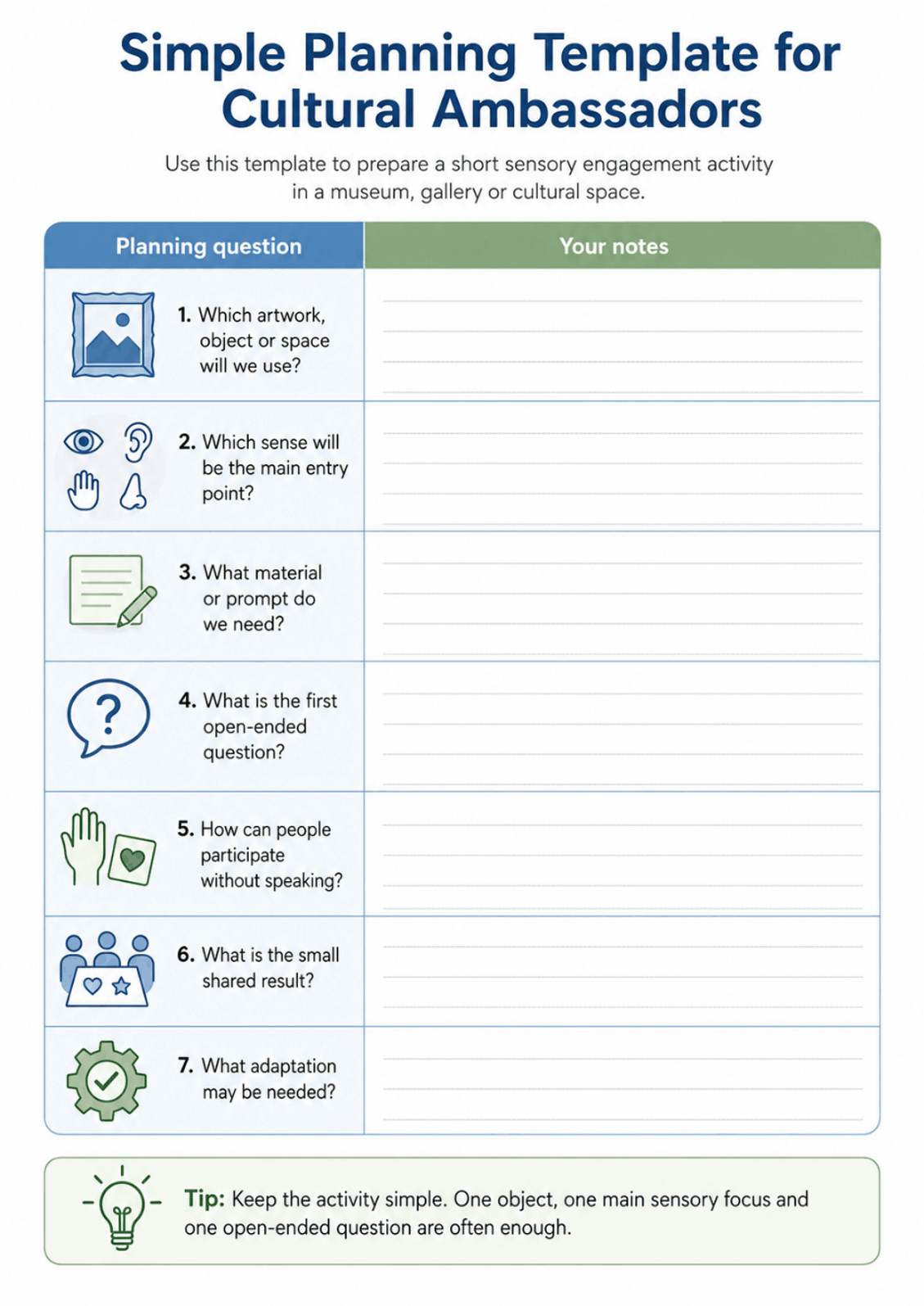
A short planning process can prevent confusion and help the activity feel natural. Cultural Ambassadors do not need to prepare a detailed lesson plan, but they should know what they want participants to notice, how they will invite participation and how the activity will end.
Figure 6: Simple Planning Template for Cultural Ambassadors
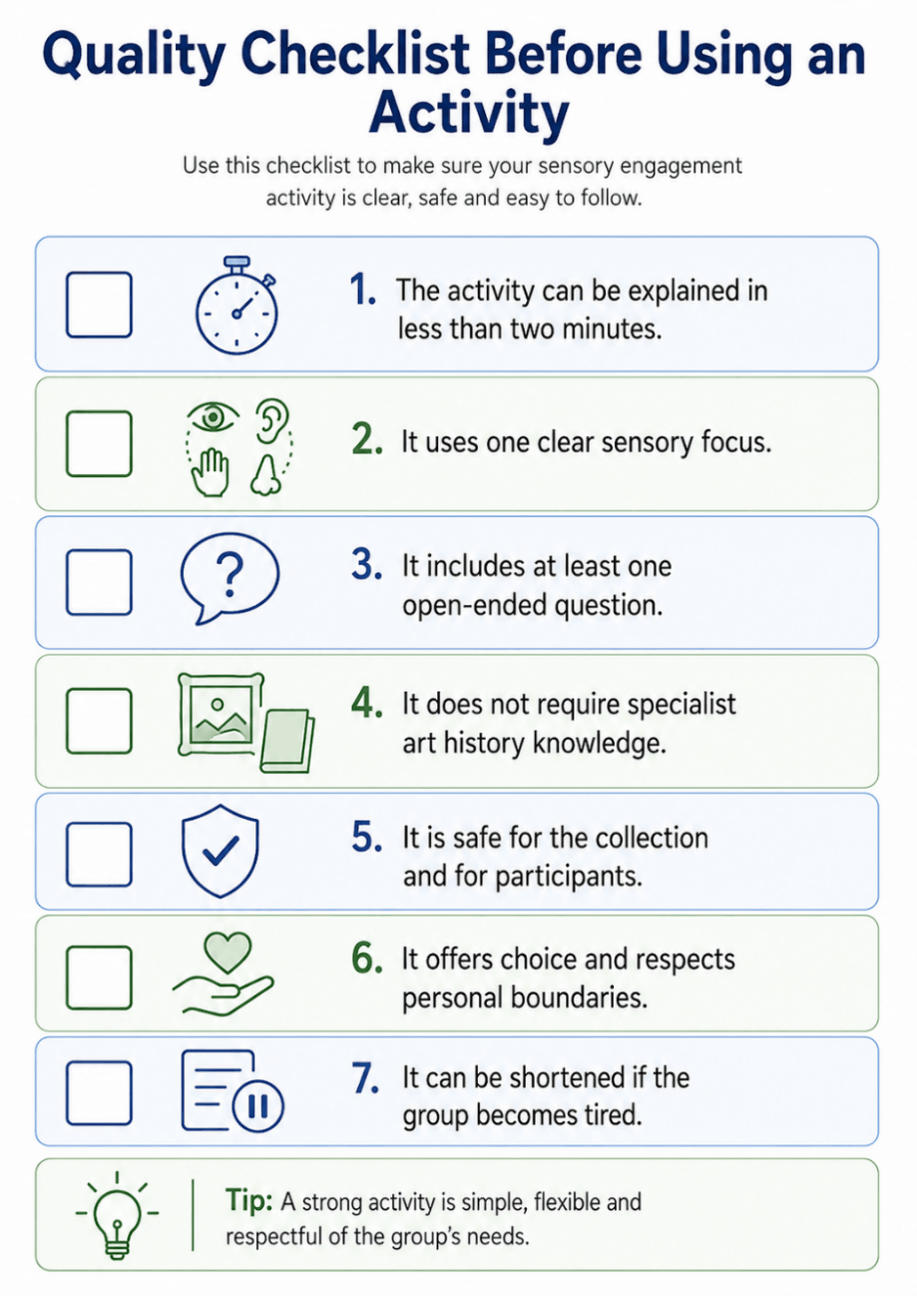
Before using an activity with a group, it is useful to review it from the participant’s point of view. A strong activity should feel understandable, safe and achievable, even for someone who has never taken part in a museum learning activity before.
Figure 7: Quality Checklist Before Using an Activity
Ambassador role
The value of a Senior Cultural Ambassador lies not in expert knowledge, but in their ability to make cultural participation feel more personal and approachable. By noticing the group’s needs, asking clear questions and valuing different responses, the Ambassador helps others engage with the cultural object or space with greater confidence.
A Senior Cultural Ambassador creates a bridge between the cultural object and the people in the group.
The following case studies and practical examples show how sensory, object-based, imaginative and senior-friendly cultural engagement can be organised. They can inspire the design of local five-senses-based activities for Cultural Ambassadors.
Case study 1: TimeSlips Creative Storytelling as inspiration for failure-free participation |
Country, city: United States, Milwaukee, Wisconsin |
Practice holder/s: TimeSlips Creative Storytelling, Inc., founded by Anne Basting, https://www.timeslips.org |
TimeSlips is a creative engagement approach originally developed to support older adults, including people living with dementia. Instead of asking people to remember facts or give correct answers, the facilitator invites them to imagine, notice and contribute ideas.
A session usually begins with an image, object, photograph or creative prompt. The facilitator asks simple open-ended questions, such as:
What might be happening here?
What sound could belong to this scene?
What could this person be thinking?
What might happen next?
Participants may answer with a word, a short sentence, a gesture, a sound or an imaginative idea. The facilitator accepts each contribution and may write the ideas down or combine them into a shared creative result.
The main purpose is not to produce a perfect story. It is to help people feel heard, involved and connected. TimeSlips encourages facilitators to move away from testing memory and towards imagination, expression and shared participation. The organisation describes its approach as supporting engagement, relationship-building, creative expression and inclusive programming.
What Cultural Ambassadors can learn from this practice:
ask questions that allow many possible answers;
avoid testing participants’ memory;
accept words, gestures and imaginative responses;
build on participants’ ideas without correcting them;
value participation more than factual accuracy;
create a small shared result, such as a title, word cloud or sensory description.
Simple example:
A group looks at a photograph of a busy market. The facilitator asks:
What sounds might we hear?
What smells could be present?
What colours feel strongest?
What might happen next?
The group answers: voices, baskets, oranges, footsteps, spices, laughter, warm air. These words can be collected into a shared sensory description. No one needs to know the date, place or people shown in the photograph.
Source: https://www.timeslips.org
Case study 2: Museum-based programmes for older people: object handling, creative activities and social connection |
Country, city: United Kingdom, London and Kent |
Practice holder/s: University College London, Canterbury Christ Church University and partner museums, https://www.ucl.ac.uk/life-sciences/culture-nature-health-research-group/research-projects/museums-prescription |
Museums on Prescription was a research-based project that connected older adults at risk of social isolation with regular museum and gallery programmes. Participants were referred through health and social care services, local authorities and third-sector organisations, and took part in weekly cultural activities rather than clinical treatment.
The sessions usually combined several elements:
guided gallery visits;
object handling;
short talks by museum staff;
collection-inspired creative activities;
group discussion;
informal social time and refreshments.
The project showed that older adults benefit most when museum activities are welcoming, varied and flexible. Comfortable seating, clear communication, breaks, personal contact and opportunities to socialise were considered just as important as the cultural content itself. Facilitators were encouraged to adapt activities to the group’s energy, confidence and practical needs.
Participants reported a stronger sense of belonging, renewed interest in learning, increased social and creative activity, greater confidence in visiting museums and continued cultural participation after the programme. The project also recorded improvements in psychological wellbeing during the museum sessions.
What Cultural Ambassadors can learn:
Senior Cultural Ambassadors can use museum objects as starting points for conversation, combine sensory and creative activities with social exchange, keep sessions manageable, offer participants choice and adapt the pace when the group becomes tired or needs more support.
Example:
During a museum visit, the Cultural Ambassador chooses one safe handling object or replica, such as an old kitchen tool, textile sample or travel item.
The group is invited to:
Look at the object closely.
Describe its shape, texture, weight or possible sound.
Answer one open-ended question, for example:
“What kind of place or moment could this object belong to?”
Share one word or short association.
Create a simple group result, such as a title or sensory word list.
For example, an old suitcase might lead to the words:
heavy, worn, train, waiting, leather, journey, goodbye, adventure.
The activity can last 10–15 minutes and does not require specialist museum knowledge. The Cultural Ambassador’s role is to encourage observation, accept different responses and help the group connect with the object in a relaxed way.
Source: Museums on Prescription: A guide to working with older people (2017). https://www.culturehealthandwellbeing.org.uk/sites/default/files/2019-08/mop-good-practice-guide.pdf
Case study 3: Sensory backpack |
Country, city: United Kingdom, Dundee |
Practice holder/s: University of Dundee Museums, https://www.dundee.ac.uk/feature/road-communities |
The University of Dundee Museums created a sensory backpack to bring parts of its collections into care homes and community settings. The backpack was designed to make museum objects more accessible to people who could not easily visit the museum.
It included:
custom 3D prints;
fabric and stone samples;
textured canvases and brushes;
perfumes;
copies of paintings;
handling objects inspired by museum collections.
The items were chosen to encourage observation, touch, conversation, memory and sensory association. For example, wooden laser-cut versions of herbarium specimens were paired with perfumes. In one care home, the scent activity brought back positive memories for a resident who had kept a large garden. The project had already reached more than 100 people when the case study was published.
What Cultural Ambassadors can learn:
A useful sensory kit does not need to contain expensive objects. Replicas, textures, images and scents can represent museum collections safely. Participants should always be allowed to choose whether they want to touch, smell, speak or simply listen. Materials should be easy to handle, easy to clean and accompanied by clear, large-print instructions.
Example
Choose one museum theme, such as plants, textiles or sculpture, and prepare a small sensory bag containing:
one image from the collection;
one texture sample;
one safe handling object or replica;
one mild scent card;
one large-print question card.
For a botanical collection, the Ambassador might use a plant image, a wooden leaf shape, a piece of textured bark and a lavender scent card. The group could be asked:
What do you notice first?
Which texture feels most connected to the plant?
What smell might belong to this place?
Which one word would you add to the group’s sensory list?
Activity 1: Five Senses Object Discovery |
Learning Objectives: To practise using the five senses as access points to a museum object or artwork. |
Learning Outcomes: Participants can describe an object through sensory words and ask one open-ended sensory question. |
Duration: 35-45 minutes |
Type (individual or group): Group activity, 6-12 participants. Can also be done in pairs |
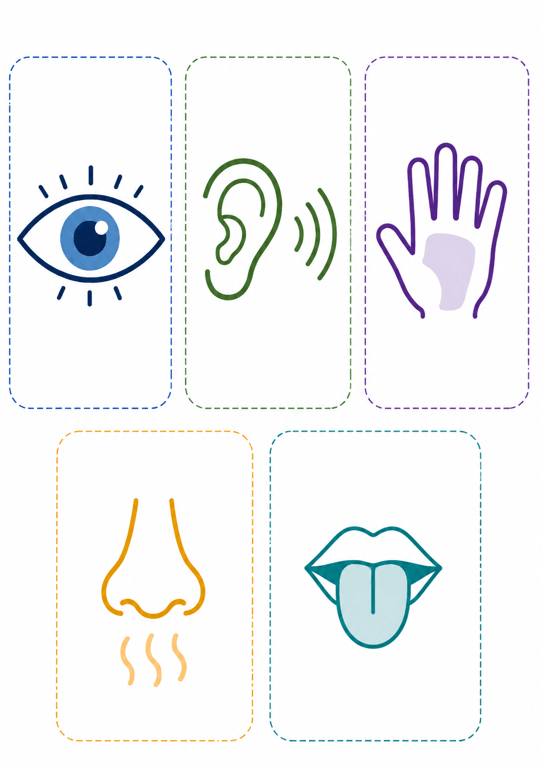
Needed equipment and materials: One safe handling object, replica, photograph or artwork reproduction; five-senses cards (see Annex 1); sticky notes; pens; large-print open-ended question starters (see Figure 3). |
Step-by-step description: Stage 1: Preparation Before conducting the activity, the facilitator should familiarise themselves with:
Choose an object or image with visible texture, colour, form or cultural associations. Ensure that the object and any sensory materials are safe and approved by the museum or gallery. Prepare or print the five-senses cards provided in Annex 1. Also prepare sticky notes, pens and the open-ended question starters presented in Figure 3 in large print. Stage 2: Implementation ● Step 1: Welcome the group and explain that there are no wrong answers. Participants may speak, write, point to a card or simply listen. ● Step 2: Invite participants to look quietly at the object or image for one minute. ● Step 3: Place the five-senses cards on the table or floor. Invite each participant to choose or point to one card and, if they wish, share one sensory word connected with the object or image. ● Step 4: Write the words on sticky notes and place them around the object or image. Ask: “Which word helps us experience this object in a new way?” ● Step 5: In pairs, invite participants to use one of the collected sensory words to create an open-ended sensory question about the object. If needed, they may use the question starters presented in Figure 3. Invite two or three pairs to share their questions. ● Step 6: Create a short group title for the object using participants’ words. Stage 3: Feedback collection Ask participants: “Which sense helped you connect most easily?” and “Was any question difficult or uncomfortable?” |
Tips and adaptations: If participants are shy, invite them to point to a card instead of speaking. If touch is not possible, use imagined touch or material samples approved by the museum. |
Annex No. 1: Example of 5 senses cards
Activity 2: Soundtrack of an Artwork |
Learning Objectives: To explore how sound and silence can support attention, imagination and group participation. |
Learning Outcomes: Participants can create a simple sound map or list of imagined sounds connected with an artwork or space. |
Duration: 30-40 minutes |
Type (individual or group): Group activity, 5-15 participants. |
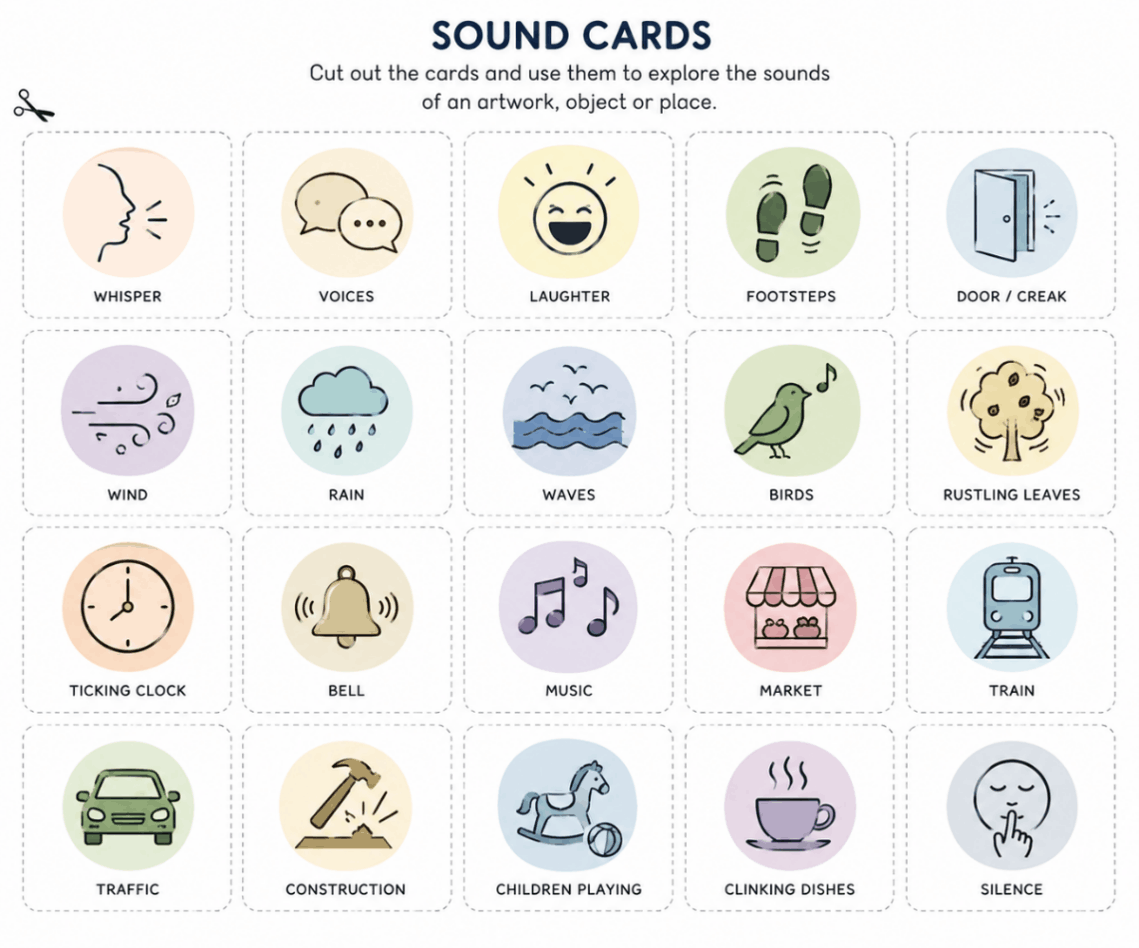
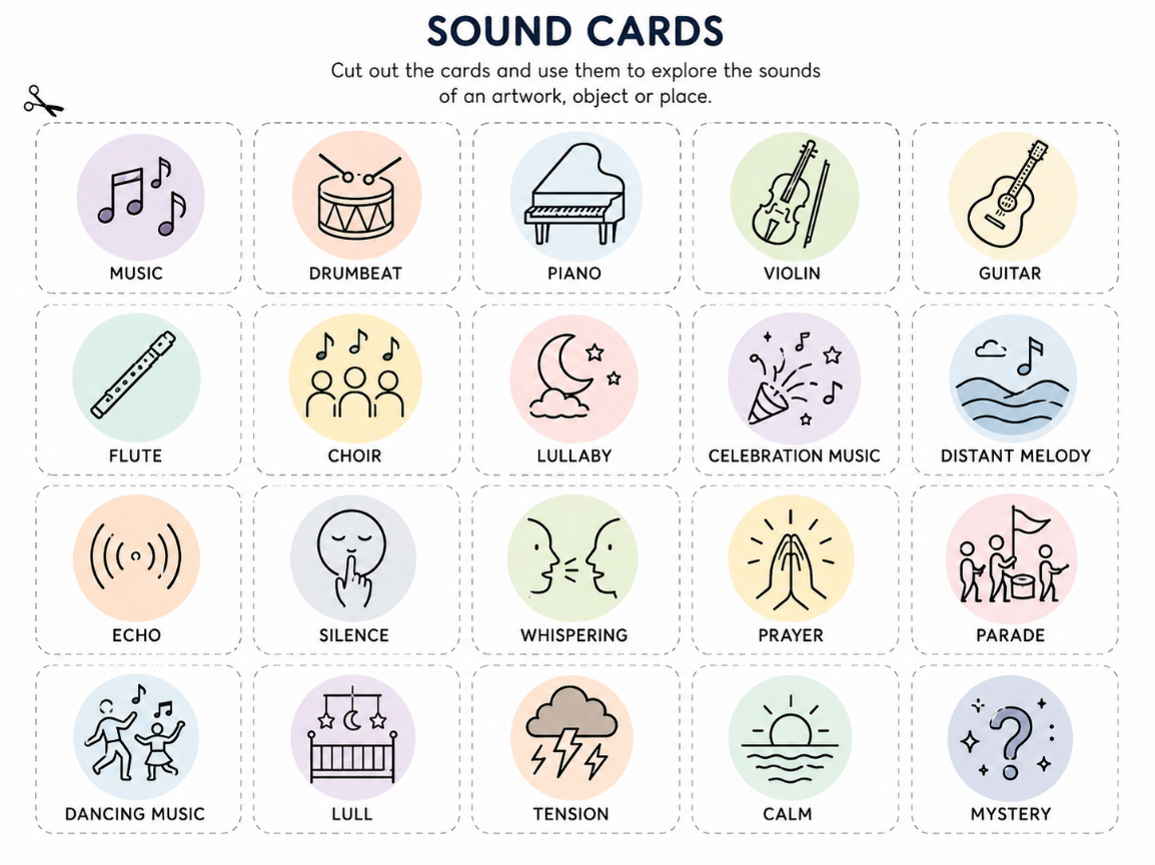
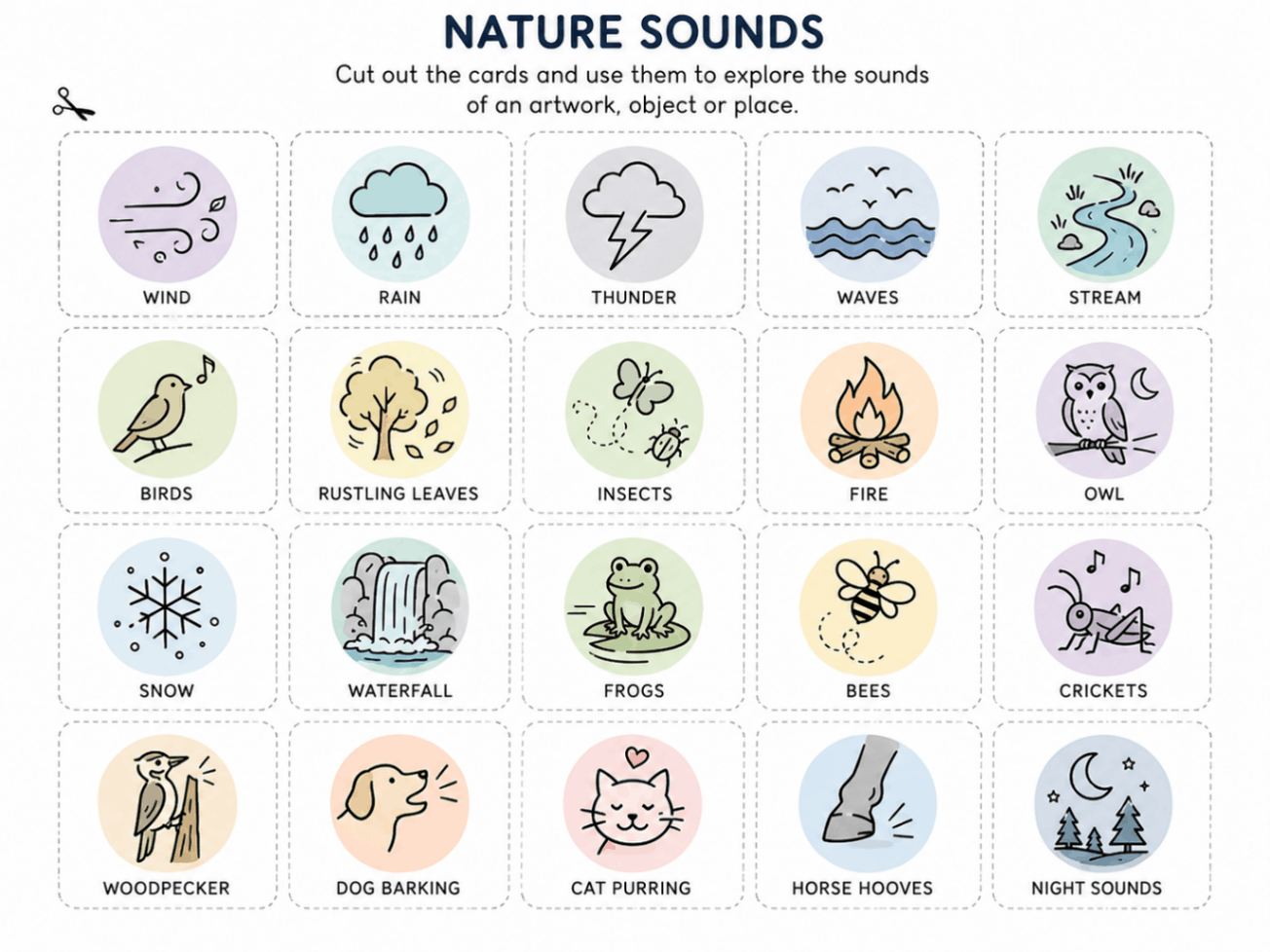
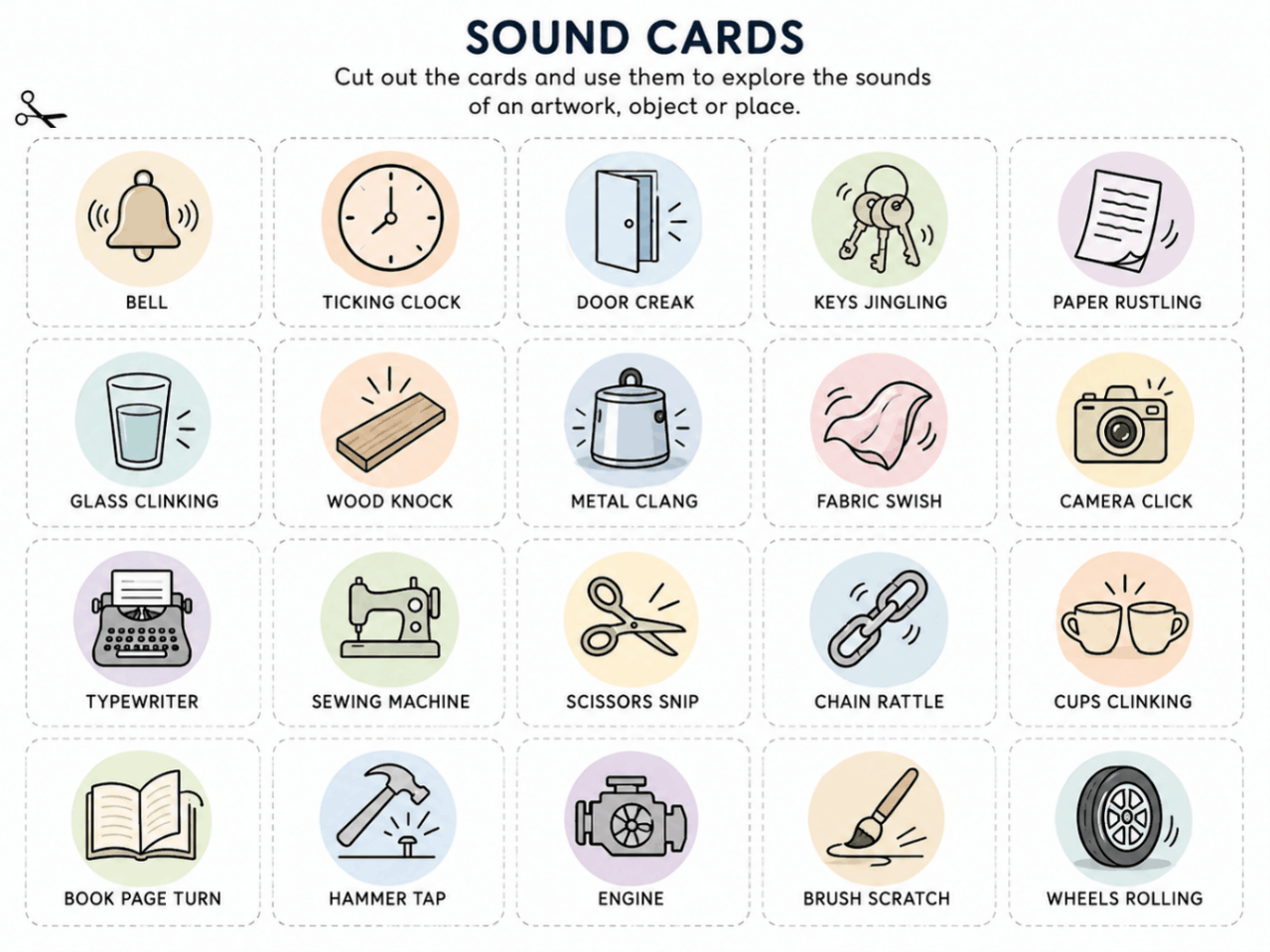
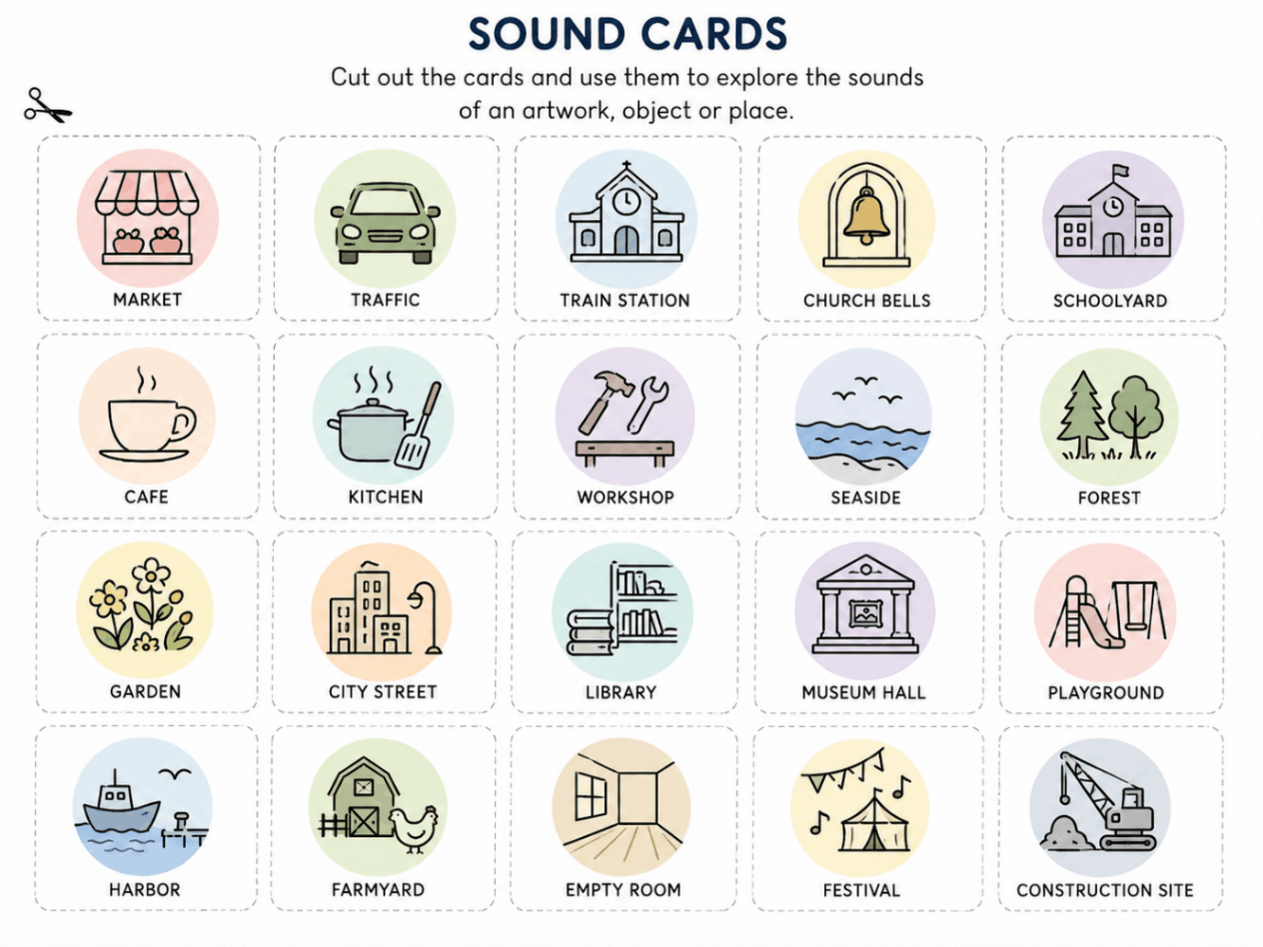
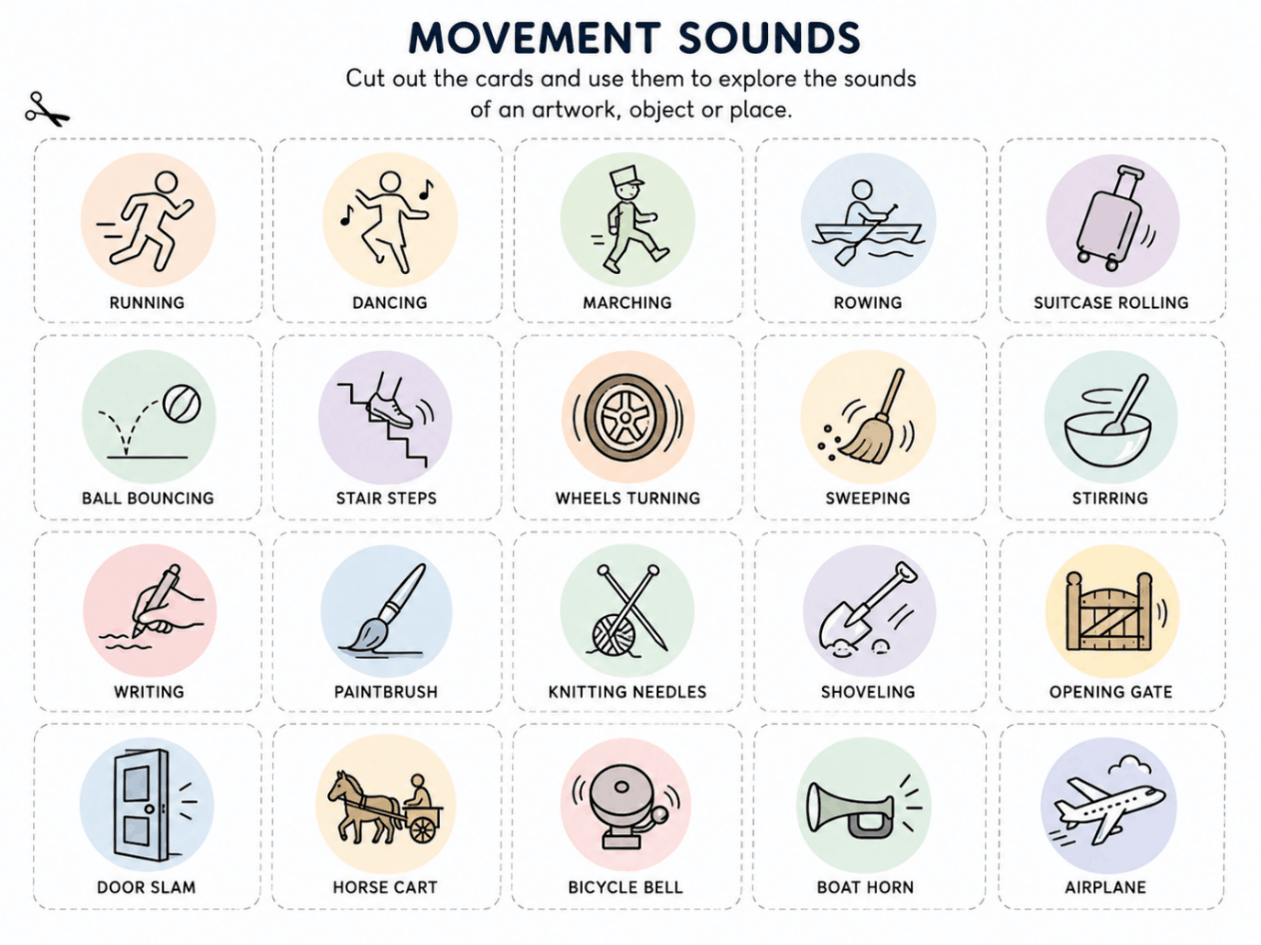
Needed equipment and materials: one artwork, gallery space or photograph; paper; pens; large-print sound cards for optional participant support (see Annex 2). |
Step-by-step description: Stage 1: Preparation Before conducting the activity, the facilitator should familiarise themselves with:
Choose an artwork, photograph or cultural space in which sounds can be imagined. If possible, select a quiet location where participants can concentrate comfortably. Decide whether the shared result will be:
Prepare or print the large-print sound cards provided in Annex 2. Also prepare paper and pens for recording the group’s sound map or list. Stage 2: Implementation Step 1: Explain that there are no correct answers and that participants may speak, point to a sound card, make a gesture or simply listen. Invite the group to observe the artwork silently for approximately one minute. Step 2: Ask: “If this scene had a sound, what might we hear?” Offer the sound cards to participants who would like additional support. Step 3: Record all contributions visibly without judging, ranking or correcting them. Step 4: Invite the group to arrange the suggested sounds into the chosen sound-list or sound-map format. For example, sounds may be grouped by type or by their imagined distance from the viewer. Step 5: Invite participants to choose one sound or combination of sounds that represents the atmosphere of the artwork. If appropriate, give the completed sound map or list a group title. Step 6: After participants have responded, add one brief factual detail about the artwork, if available. Stage 3: Feedback collection Ask: “Did sound help you notice something new?” Participants may answer with one word or a gesture. |
Tips and adaptations: For participants with hearing difficulties, use printed sound words and visual sound symbols. Reduce background noise and face the group when speaking. If recorded audio is used, keep it at a comfortable volume and check participants’ consent beforehand. |
Annex No. 2.: Example of sounds cards
Activity 3: Imagining Texture Without Touching the Original Object |
Learning Objectives: To practise safe tactile imagination when original museum objects cannot be touched. |
Learning Outcomes: Participants can use visual details and material samples to describe imagined textures respectfully and safely. |
Duration: 40 minutes |
Type (individual or group): Small group activity, 4-10 participants. |
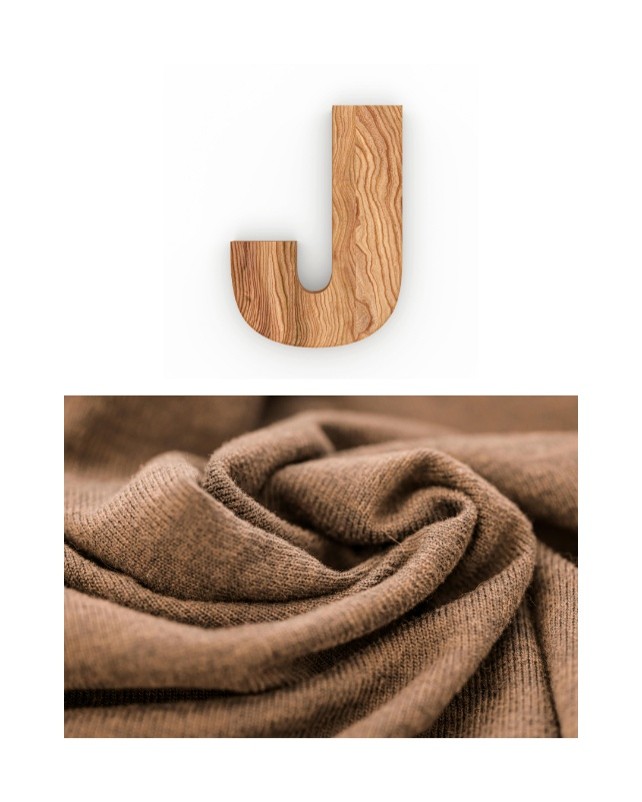
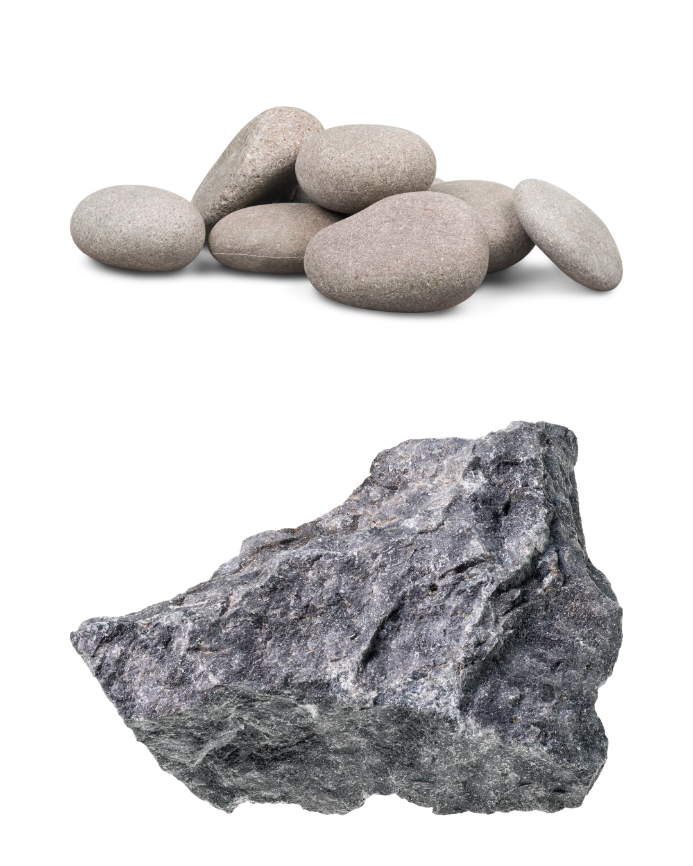
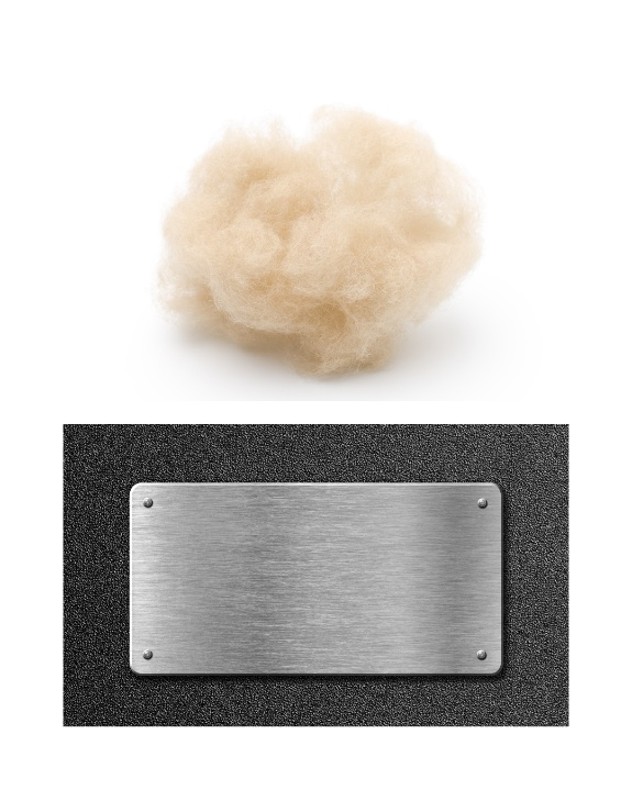
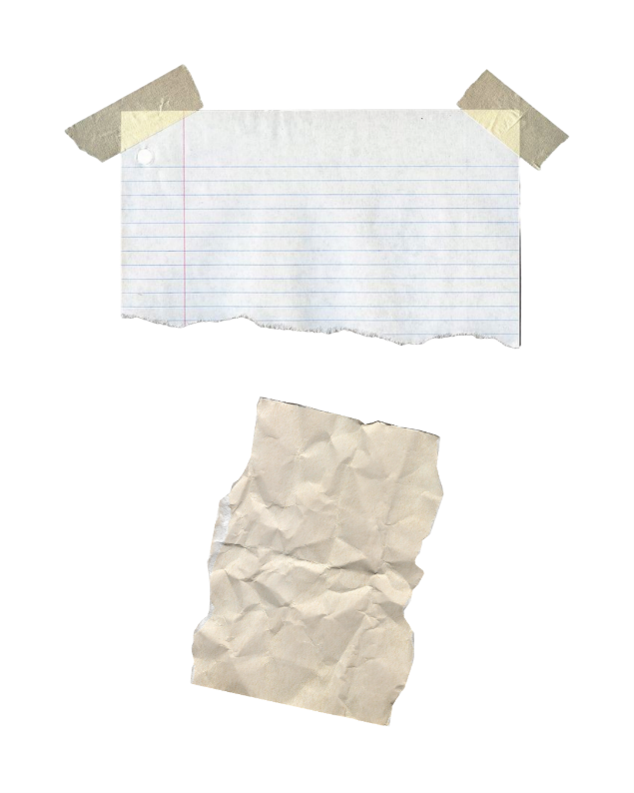
Needed equipment and materials: One artwork, museum object or high-quality image; approved and clean texture samples such as fabric, wood, smooth stone, paper, metal or wool; a clean cloth or tray; hand wipes if needed; a large sheet of paper; marker; stickers. |
Step-by-step description: Stage 1: Preparation Before conducting the activity, the facilitator should familiarise themselves with:
Consult museum or gallery staff about which handling materials may be used. Choose an artwork, object or image with clearly visible surface qualities. Prepare approved texture samples that relate to the materials or surface qualities visible in the artwork or object. They do not need to reproduce the original material exactly. The examples provided in Annex 3 may be used as guidance. Ensure that all samples are clean, free from sharp edges and comfortable to handle. Consider allergies, tactile sensitivities and hygiene requirements. Prepare an alternative way to participate for anyone who does not wish to touch the samples. Stage 2: Implementation Step 1: Explain that the original artwork or museum object is protected and will not be touched. Only the approved material samples may be handled. Emphasise that touching the samples is optional and that there are no correct answers. Step 2: Before presenting the samples, invite participants to observe visible surface details. Ask them to consider qualities such as smooth, rough, glossy, matte, cracked, even, uneven, hard or soft. Step 3: Offer the approved samples one at a time to participants who wish to handle them. Ask: “Which sample looks or feels closest to the texture you imagine?” Participants who prefer not to touch may look at the samples, point to one or describe an imagined texture. Step 4: Invite participants to connect one texture word with one visible detail in the artwork or object. Record their words on a large sheet of paper to create a shared “texture vocabulary” list. Step 5: Close by asking: “How did imagining the texture change the way we looked at the artwork or object?” Stage 3: Feedback collection Invite participants to place a sticker beside the texture word they found most useful or interesting. Participants may point to a word if they prefer not to use a sticker. |
Tips and adaptations: Never require participants to touch a material. For participants with low vision, provide a clear verbal description and offer approved tactile samples. For participants with tactile sensitivities, allow visual observation, pointing or verbal participation. Check allergies, hygiene requirements and the condition of every sample before use. |
Annex No. 3.: Safe texture examples
Activity 4: Designing an Open-ended Sensory Prompt Purpose: For Cultural Ambassadors to practise creating one simple open-ended question that helps people explore an artwork through the senses. |
Learning Objectives: To practise turning a sensory idea into a clear, open-ended question with multiple possible answers. |
Learning Outcomes: Each pair or small group creates and tests one ready-to-use open-ended sensory question card. |
Duration: 30–40 minutes |
Type (individual or group): Pairs or small groups, 6-16 participants. |
Needed equipment and materials: A selection of artwork or museum-object images, with at least one image for each pair or small group; five-senses cards (see Annex 1); blank question cards; pens; large-print example questions or question starters (see Figure 3); a question-review checklist. |
Step-by-step description: Stage 1: Preparation Before conducting the activity, the facilitator should familiarise themselves with:
Prepare one large-print question-review checklist for each pair or small group, using the review questions provided in Step 3. Prepare a selection of artwork or museum-object images and ensure that each pair or small group can choose one. Prepare the five-senses cards provided in Annex 1, blank question cards, pens and the question starters presented in Figure 3. Show one example image and explain that a closed question usually has one correct answer: “Is this object made of wood?” An open-ended sensory question allows many possible answers: “What texture do you imagine this object has?” Explain that participants are not expected to know facts about the artwork or object. They are invited to notice, imagine and respond. Emphasise that a good sensory question should be simple, connected with the selected artwork or object, open to different answers and respectful of personal boundaries. Stage 2: Implementation Step 1: Each pair or small group chooses one artwork or museum-object image and one sensory access point: sight, sound, touch, smell or taste-related association. Step 2: Participants use one of the following sentence starters to create an open-ended sensory question:
They write one complete question on a blank card. For example: “What sound could this sculpture make if it moved?” Step 3: Each pair or small group exchanges its question card with another pair or group. One group asks the question, and the other responds freely. Participants may answer verbally, write, point or choose not to answer. Together, they review the questions:
Return each question card to its creators. They may revise the wording based on the responses and checklist. Step 4: Display the completed cards as a small Cultural Ambassador Sensory Question Set. Stage 3: Feedback collection Ask participants:
Participants may respond verbally, indicate a question card or write a short response. |
Tips and adaptations: Avoid questions that directly request private memories or personal disclosure. Use gentle invitations such as “What might…?” or “What could…?” instead of “Tell us about your past.” Ensure that participants may respond in different ways or choose not to answer. Question starters may be provided in large print or paired with the five-senses cards from Annex 1. |
Sensory engagement helps museums and galleries become more active, personal and welcoming learning spaces for seniors. By using sight, sound, touch, smell and taste-related associations, Cultural Ambassadors can support participation without turning the visit into a test of art knowledge. Simple sensory prompts help people notice more, respond in different ways and feel that their contribution matters.
TimeSlips-inspired principles strengthen this approach by reminding facilitators to use open-ended prompts, accept different answers and create failure-free participation. For Cultural Ambassadors, this is especially valuable: their role is to create bridges between people, artworks, objects and cultural spaces.
• Sensory engagement moves museum learning from passive looking to active experiencing.
• The five senses can be used directly, indirectly or imaginatively, depending on safety and context.
• Good sensory prompts are simple, respectful, safe and connected with the cultural object or space.
• Open-ended questions encourage participation because they do not require one correct answer.
• TimeSlips-inspired principles support imagination, acceptance and failure-free participation in sensory engagement activities.
• Senior Cultural Ambassadors can design short, adaptable activities that help peers feel confident and included.
Term | Simplified explanation |
Cultural Ambassador | A senior or adult learner who helps encourage participation, peer support and cultural engagement in museums, galleries or cultural spaces. |
Sensory engagement | Learning through the senses: sight, sound, touch, smell and taste-related associations. |
Five-senses-based activity | A short activity that uses one or more senses to help people connect with an artwork, object or space. |
Sensory access point | A simple sensory route into cultural engagement, such as colour, sound, texture or smell. |
Sensory prompt | A question, object, material, sound or image that invites sensory noticing. |
Open-ended question | A question that allows many possible answers and does not test factual knowledge. |
Failure-free participation | A way of participating where there are no wrong answers and no pressure to perform. |
TimeSlips activities | Creative engagement activities developed by TimeSlips that use open-ended prompts, imagination and participants’ contributions instead of testing memory or factual knowledge. They are particularly used to support meaningful participation among older adults, including people living with dementia. |
TimeSlips-inspired | Using selected principles linked with TimeSlips, such as imagination, open-ended prompts and acceptance. It does not mean official TimeSlips certification. |
Handling object | An object, replica or sample that participants are allowed to touch safely. |
Replica | A copy of an object used for learning, especially when originals cannot be touched. |
Material sample | A small piece of fabric, wood, paper, metal or other material used to explore texture safely. |
Personal association | A thought, feeling or connection that a person makes from their own experience. |
Imaginative response | A creative answer based on imagination rather than factual knowledge. |
Facilitation | Supporting a group activity by inviting participation, listening and guiding the process. |
Adaptation | Changing an activity to fit participants’ needs, comfort, confidence or abilities. |
1. Crawford, A. (2022). On the Road to Communities. University of Dundee.
https://www.dundee.ac.uk/feature/road-communities
2. D’Andrea, F., Dening, T., & Tischler, V. (2022). Object handling for people with dementia: A scoping review and the development of intervention guidance. Innovation in Aging, 6(5), igac043.
https://doi.org/10.1093/geroni/igac043
3. Museums Galleries Scotland. (2023). Creating a sensory backpack at University of Dundee Museums.
https://www.museumsgalleriesscotland.org.uk/sector-story/creating-a-sensory-backpack-at-university-of-dundee-museums/
4. Thomson, L. J., Lockyer, B., Camic, P. M., & Chatterjee, H. J. (2018). Effects of a museum-based social prescription intervention on quantitative measures of psychological wellbeing in older adults. Perspectives in Public Health, 138(1), 28–38.
https://doi.org/10.1177/1757913917737563
5. TimeSlips Creative Storytelling. (2019). TimeSlips storytelling program launches a creative care revolution for people living with dementia.
https://www.timeslips.org/news-post/timeslips-storytelling-program-launches-a-creative-care-revolution-for-people-living-with-dementia/
6. TimeSlips Creative Storytelling. (2021). Get Engaged! Introducing the TimeSlips Engagement Parties.
https://www.timeslips.org/get-engaged-introducing-the-timeslips-engagement-parties/
7. Todd, C., Camic, P. M., Lockyer, B., Thomson, L. J. M., & Chatterjee, H. J. (2017). Museum-based programs for socially isolated older adults: Understanding what works. Health & Place, 48, 47–55.
https://doi.org/10.1016/j.healthplace.2017.08.005
8. Ucar, E. (2015). Multisensory Met: Touch, smell, and hear art. The Metropolitan Museum of Art.
https://www.metmuseum.org/perspectives/multisensory-met
9. Veall, D., et al. (2017). Museums on Prescription: A guide to working with older people.
https://www.culturehealthandwellbeing.org.uk/sites/default/files/2019-08/mop-good-practice-guide.pdf
10. TimeSlips Creative Storytelling. Official website and creative-engagement resources.
https://www.timeslips.org
11. Museum-Ed. Involving the senses makes sense.
https://www.museum-ed.org/involving-the-senses-makes-sense/
12. Museums should activate multiple senses, not just the eyeball [Video]. YouTube.
https://www.youtube.com/watch?v=m1-r7CR6FsI
13. Kids in Museums. Welcoming families with special educational needs and disabilities.
https://kidsinmuseums.org.uk/resources/welcoming-special-needs-families/