Learning Content
This module helps seniors (55+) and adult educators to identify and remove barriers in museums and galleries. These barriers can be physical, digital, structural, or language-related. The module prepares participants to become Cultural Ambassadors so that they can help make cultural spaces friendly, accessible, and open to everyone.
● To study the main barriers in modern museums, including physical, digital, institutional, and language barriers.
● To give participants practical ways to check physical barriers, with a focus on seating and moving around easily.
● To understand why older adults might face digital exclusion and learn how to help peers use museum technology safely.
● To show how sharing life stories can bring different age groups together and create an environment of social safety.
● To teach the rules of simple language and translations in order to help seniors from different cultures feel included.
● To train museum professionals and senior leaders to use social networks and clear communication in order to build a welcoming local community.
● Clear understanding of physical needs in a museum, such as comfortable seating, open paths, and good lighting.
● Awareness of digital tools like apps or touchscreens, including common problems they cause and how to help peers use them.
● Familiarity with the rules of plain text and the translation needs of seniors from different cultures or displaced groups.
● Insight into how cultural institutions can shift from basic politeness to an active, welcoming approach for older visitors.
● Familiarity with cross-generational dialogue techniques and the role of shared life experiences in building group unity.
● Conduct basic accessibility evaluations of local cultural venues and recommend actionable solutions for structural improvement.
● Guide peers through complex digital museum applications and touchscreens to build their technological confidence.
● Adapt sophisticated or academic exhibition texts into clear, simplified language suitable for diverse audiences.
● Reach out through personal social networks and local community connections to safely engage and invite socially isolated seniors.
● Facilitate inclusive group discussions that respect and integrate different cultural backgrounds and generational views.
Active aging requires a significant change in how cultural institutions view their senior visitors. While museums and galleries frequently provide targeted educational programmes for children and young students, active seniors (55+) are often treated as passive observers rather than engaged learners. True cultural inclusion requires that institutions move past basic politeness to actively remove the structural, digital, operational, and linguistic barriers that restrict senior participation.
According to cross-border data on European cultural participation and active aging, physical discomfort (such as absence of seating or poor mobility management) and digital exclusion (such as digital screens with no instructions or complex ticketing apps) represent significant obstacles for senior citizens. Furthermore, shifting European demographics require that cultural organizations address linguistic barriers to support displaced or culturally diverse older groups, turning spaces into safe environments for intergenerational dialogue.
This module provides future Cultural Ambassadors and adult educators with the actionable skills needed to evaluate spaces, utilize personal social networks, navigate digital tools, and co-create an atmosphere of mutual trust. By training museum staff and senior advocates together, we transform traditional cultural venues into dynamic, inclusive, and accessible lifelong learning hubs.
Overcoming technology-related exclusion in museums begins with a strategy of identifying and mapping institutional obstacles. Rather than treating technology as a generalized challenge, Cultural Ambassadors focus on the everyday hurdles highlighted by older adults in the MUGArtS combined European report on Seniors' Museum and Gallery Experiences. These specific obstacles include complex mobile ticketing applications, digital screens with no instructions, and exhibit labels that rely solely on QR codes without written alternatives. The primary strategy requires peer guides to try out these digital tools before a group visit, anticipating where technical confusion might occur. By shifting from a passive observation approach to an active site visit, ambassadors can turn potential sources of tech anxiety into planned, accessible learning moments.
Traditional technical instruction often fails because it leaves the learner feeling left out, whereas our main approach focuses on informal, group-based adult education to build collective confidence. The data in the cross-border analysis shows a clear rejection of impersonal digital learning in favor of social, face-to-face community environments. To address this, Cultural Ambassadors apply a strategy of low-pressure peer mentoring that prioritizes social invitations, emotional reassurance, and mutual patience. By organizing seniors into small helpful teams, the threat of making a public mistake is entirely removed. This supportive group environment establishes an atmosphere of mutual trust, empowering hesitant participants to approach digital museum tools with curiosity rather than fear.
The primary practical method for on-site digital introduction is the structured "Watch-Try-Do" strategy, which ensures older adults maintain full physical independence over their learning experience. This strategy unfolds in three distinct, carefully paced phases during a museum visit:
The peer-to-peer "Watch-Try-Do" Strategy
|
|
|
|
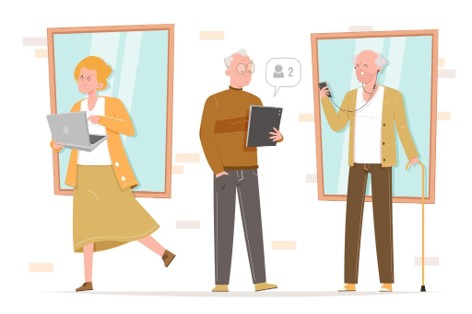
To effectively equip our Cultural Ambassadors with the essential digital skills to assist less confident peers, their own hands-on digital preparation is delivered through the previously mentioned highly structured, pressure-free "Watch-Try-Do" instructional pathway, as well, that directly addresses the senior-specific learning barriers.
The "Watch-Try-Do" Strategy for the Ambassadors |
|
|
|
Shared storytelling serves as an effective mechanism to bridge generational gaps within cultural spaces, allowing senior learners to utilize their unique life experiences in order to create meaningful connections with younger generations. By transforming standard museum visits into interactive discussions, these practical approaches highlight how personal memories, local history, and diverse viewpoints add value to the interpretation of artistic works for all age groups involved.
Within the setting of a museum or art gallery, the personal memory of senior participants serves as a generational living heritage that adds depth to traditional history records. By introducing personal stories and recollections and diverse life perspectives during public gallery visits, senior learners provide younger generations with a relatable, meaningful connection into history, consequently building deep empathy and cross-generational understanding.
To achieve organized community connection the project utilizes a flexible adult learning approach, based on shared, hands-on collaboration. Building on the previously established "Watch-Try-Do" step-by-step process, this learning structure moves senior participants from learning how to share personal stories to gaining experience and leading group discussions in safe and comfortable practice sessions. This ensures they possess the necessary tools and guidance to lead public cultural events.
On a practical level, seniors achieve this intergenerational dialogue by sharing focused personal stories inspired by specific cultural artifacts or artworks. Rather than delivering traditional, one-sided presentations, seniors select exhibition items that reflect their own life experiences and utilize creative conversation tools. Some good examples are thought-provoking questions, recollections of sights, sounds, and textures, as well as the “TimeSlips method,” which focuses on creative imagination rather than memory to invent stories about art. These tools serve to invite younger visitors into active conversation. Seniors guide these short interactive discussions by asking younger participants to compare the historical context of the artwork with today’s societal changes, ultimately developing a shared, well-rounded interpretation of the piece.
Artwork as an inspiration for dialogue: | A senior and a youth are paired in front of an everyday object from the past (e.g., a vintage rotary phone or an old manufacturing tool). |
The Exchange: | The senior shares a brief, personal memory regarding how that object shaped daily life. The youth reflects on its modern digital equivalent. |
The Outcome: | This low-pressure exchange shifts the museum dynamic from an individual viewing experience to a shared space of mutual respect, building the social confidence of the senior participant. |
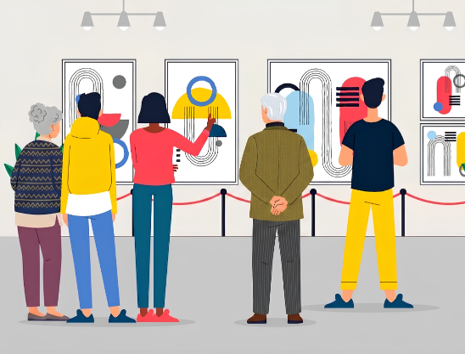
Equipping future Cultural Ambassadors and adult educators with practical tools to identify, evaluate, and manage physical accessibility challenges within cultural venues is vital for the creation of welcoming and accessible events.This preparation relies on simple yet effective methods for evaluating how easily visitors can move through the space, ensuring sufficient and well-placed seating and planning accessible, restful tour routes. To support everyone effectively, this approach is designed for effortless reading and quick review for senior learners.
Physical comfort is the very first step toward creating an inclusive museum experience. According to the recent results of the multi-country study conducted by MUGArtS, physical accessibility remains a primary concern for older adults, with up to 66.7% of respondents in some partner regions identifying it as a major obstacle to regular attendance. When a cultural space lacks clear paths or senior-friendly physical accommodations, it causes physical fatigue and lowers a visitor's confidence. Therefore, learning how to recognize and reduce these physical barriers is a primary focus for anyone stepping into the role of a Cultural Ambassador.
To ensure an exhibition is truly welcoming, Cultural Ambassadors can perform a basic physical space evaluation using a simple checklist guide. This involves walking through the museum layout prior to a group visit to look at the space through the eyes of an older adult or someone with limited mobility. Key elements to observe include the clear and readable signs, the availability of ramps and step-free entrances, smooth floor surfaces that prevent slipping, and well-lit galleries. By identifying potential physical barriers early on, Cultural Ambassadors can work alongside museum staff to request immediate adjustments, such as clearer printed directions or open pathways.
Adequate seating is not just a structural necessity. It is a basic physical requirement that supports meaningful connection and deep interest with art. The cross-border analysis conducted by MUGArtShighlights that having the time to look slowly and reflect is highly valued by senior participants. However, thoughtful, unhurried observation is only possible if visitors have comfortable places to rest during their journey. Cultural Ambassadors can practically manage this by mapping out the location of benches, chairs, and lightweight portable stools throughout the galleries. Ensuring that a rest stop is available near major or complex artworks allows senior visitors to sit down, avoid physical discomfort, and focus entirely on the storytelling and group discussion.
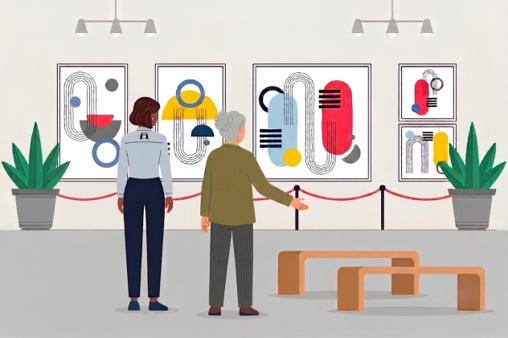
The final step in managing physical spaces is the co-designing easy-walking visiting routes. Seniors can actively collaborate with educators to map out the shortest and most accessible paths through an exhibition. This route planning aims to minimize unnecessary walking distance, avoid long staircases, and guarantee easy access to elevators and restrooms. By choosing a relaxed pace and a clear, logical route, Cultural Ambassadors protect their peers from exhaustion, transforming a standard, tiring museum tour into a safe, low-pressure, and highly enjoyable community activity.
Area of assessment | Potential Physical Barrier | Cultural Ambassador Action/ Solution |
Route planning & Mobility |
|
|
Navigation Safety & Entry |
|
|
Gallery Viewing and Engagement |
|
|
Reaching out to personal circles of friends and acquaintances allows future Cultural Ambassadors to bring to life a warm, inclusive environment within museums and cultural venues. By building on everyday relationships like friends, neighbors, and community clubs, adult learners can apply practical, stress-free methods for inviting peers to encourage participation from local residents. This approach perfectly blends a warm, welcoming approach for seniors with official learning requirements to create a strong, positive difference locally.
Social connection is often the turning point that welcomes an isolated senior into active community life. According to the cross-border research findings a "lack of company" and a lack of social connection serve as significant barriers preventing older adults from visiting museums and galleries regularly. For many seniors, entering an imposing cultural venue alone can feel intimidating or uninviting. By utilizing personal social networks, Cultural Ambassadors can act as trusted companions, turning an overwhelming visit into a shared, reassuring, and meaningful social experience that immediately reduces the feeling of isolation.
A personal, warm invitation from a peer carries far more emotional weight than a generic museum advertisement. When a Cultural Ambassador reaches out to their own inner circle through a casual phone call, a chat at a community group, or a message to a neighbor, they break down psychological barriers. This peer-to-peer approach transforms the museum visit not as an intimidating or overly formal academic event, but as a friendly gathering where every participant's presence is genuinely valued.
Reaching out to personal circles requires a simple, step-by-step approach to mapping out local community centers. Cultural Ambassadors can identify senior social clubs, neighborhood groups, and supporting local networks.By creating a regular line of communication with these centers, ambassadors can provide clear and simple details about upcoming events, plan scheduled group meetups to travel together and coordinate transportation. This shared planning ensures that no senior is left behind due to a lack of company or confusion over travel arrangements.
The final and most crucial element of utilizing social circles is managing the atmosphere during the actual cultural visit. As highlighted in the cross-border analysis, older learners deeply emphasize the importance of a respectful, accepting, and welcoming environment. Cultural Ambassadors can practically nurture this by welcoming participants individually, introducing group members to one another, and establishing a relaxed pace. By protecting hesitant peers from stressful expectations and encouraging simple, friendly conversations the ambassador creates a safe social space where closer community ties can grow around art and culture.
Clear communication forms the starting point for assisting people as they settle into a new community. For displaced individuals and culturally diverse communities, navigating new and complex ways of doing things can be deeply challenging. Typical instruction manuals often contain specialized phrases or technical terms that do not translate easily across different cultures.
Adopting simplified language helps connect across communication barriers effectively. This approach focuses on brief, uncomplicated sentences, conversational, lively wording and everyday language. By avoiding overly complex vocabulary, the core message remains inviting and easy to read for all participants, regardless of their native language or their educational background.
Accurate translation and shaping the lessons to the audience's culture are equally essential to the success of the training module. Successful projects do not rely on literal, word-for-word translations. Instead, they adapt the core ideas to connect directly with the specific customs, values, and traditions of the audience. This wise tailoring ensures the information feels respectful and familiar.
Visual support and offering texts in multiple languages build on the overall learning experience. Combining short, uncomplicated paragraphs with universally understood symbols or diagrams allows participants to take in the most important points quickly. Providing materials in a variety of ways ensures that every individual feels included, respected, and fully capable of participating.
An encouraging peer mentor completely changes how visitors of all generations and life experiences interact with art. Cultural Ambassadors serve as cultural bridges, establishing an atmosphere of patience, respect, and mutual understanding. Staying true to the senior preferences highlighted in the cross-border analysis, they offer comfortable, "stress-free settings” where quiet listening and observing are fully valued. By supporting learning at a relaxed pace, ambassadors help fellow participants from different cultures build lasting community connections.
Focus Area | Core Action | Benefit for Participants |
Clear Wording | Use of short sentences and everyday language. | Makes the information easy to follow and understand. |
Cultural Respect | Adapt concepts to match local customs and traditions. | Helps everyone feel included, valued and respected. |
Visual Helpers | Pair short text with helpful symbols and pictures. | Allows quick understanding without relying on reading. |
Training museum, gallery, and cultural staff to create clear and accessible communication channels for senior visitors is essential for creating inclusive cultural spaces. Developing these face-to-face and digital interaction skills ensures that on-site guides and hosts can effectively welcome senior learners and guide them with confidence and clarity.
8.1. Training Cultural Workers for Senior Inclusion
Creating clear, meaningful communication requires focused training and support for museum and gallery personnel. According to the community surveys conducted by the partners of MUGArtS, museum and gallery professionals frequently report a lack of specific skills needed to support senior visitors effectively. This training addresses that gap by transforming the museum's approach from basic hospitality to hands-on personalized assistance. Museum and gallery professionals learn to identify how seniors naturally prefer to connect and shape their communication style accordingly.
8.2. Designing Accessible Information Pathways
Clear visual presentation prevents confusion and reduces mental strain for senior visitors. To support this, staff are trained to remove overly academic language and complicated historical terms, focusing instead on replacing complicated signage and promotional materials with simplified language, large fonts, and clear, sharp color contrasts. This ensures that key details regarding exhibitions, schedules, and directions are readable at a single glance.
8.3. Creating Inclusive Face-to-Face Communication Channels
Direct human interaction remains the most effective way for building trust with senior learners. Through inclusive community approaches, cultural professionals learn to practice active listening and patient clear communication, they are trained to avoid rushed explanations, they offer clear and helpful instructions and welcome thoughtful silence .This creates a highly supportive, low-pressure atmosphere that makes seniors feel respected and valued.
8.4. Managing Digital Communication and On-Site Support
As cultural institutions adopt digital tools, staff must ensure these methods do not exclude senior visitors. Findings from the cross-border analysis highlight that digital barriers and complicated online features significantly limit senior participation. Digital training equips museum professionals to offer patient, in person digital-assistance for touchscreen displays, audio guides, or tablets. Cultural institution staff also learn to create user-friendly website designs that allow seniors to access cultural content independently.
This section highlights real-world European initiatives that demonstrate how to build active, accessible communication systems within museums and heritage sites.
Case study 1: The ITEMS Training Programme for Museum Explainers |
Country, city: Munich, Germany |
Practice holder/s: Deutsches Museum (www.deutsches-museum.de) |
The ITEMS training initiative addresses the specific communication gaps between museum hosts and senior learners, focusing on reducing language barriers and mental fatigue during educational visits. The programme transforms the way museum personnel interact with the public by replacing rigid, academic lecturing with active listening and dialogue-driven language that makes senior visitors feel valued and included.
Through its dedicated "On Welcome and Speech" philosophy, cultural workers learn to slow down their speaking rhythm, use simplified terminology, and naturally guide group discussions. Additionally, the training programme provides practical tools for guides to manage the immediate physical and acoustic setting, allowing them to reduce background sound, arrange seating for maximum comfort, use visual elements to prevent information overload and create a vivid learning experience for active seniors.
Case study 2: "Hecho a Medida" (Custom Made) – Performative and Theatre-Based Inclusion for Seniors |
Country, city: Madrid, Spain |
Practice holder/s: Museo Nacional Thyssen-Bornemisza (www.museothyssen.org/ www.educathyssen.org) |
This community-based programme targets active seniors, seniors from local day centers, and elderly individuals experiencing social isolation. The initiative aims to ease the hesitation of visiting fine art museums by utilizing creative movement and body language, storytelling, and improvisational theatre to unpack the stories behind classical and modern paintings.
Instead of merely viewing the collections, senior participants work alongside theatre educators and museum curators to co-create short, live performative pieces inspired by the artwork. By translating visual compositions into physical gestures, dialogue, and personal monologues, seniors actively exercise their memory, improve physical movement, and reclaim cultural spaces as shared environments for active participation and creative aging.
Source: https://www.museothyssen.org/en/educathyssen
https://www.educathyssen.org/educacion-accion-social/hecho-medida-adultos
Case study 3: Seeing with the Senses" (Vlepontas me tis Aisthiseis) – Sensory and Storytelling-Based Cultural Access for Seniors |
Country, city: Athens, Greece |
Practice holder/s: Benaki Museum (www.benaki.org) |
This case study focuses on combining hands-on and visual activities with interactive storytelling for senior citizens, directly guided by the core principles of the training while resolving the accessibility needs identified also in the cross-border analysis data.
This innovative project is created specifically for older generations, including active seniors seeking lifelong learning and individuals living with diverse memory and sensory needs. The programme shifts away from the traditional, passive museum tour by engaging all the senses by weaving in high-quality detailed models crafted for handling, background music and sound effects that set the scene, and recognizable scents that bring back memories tied to the exhibitions.
Working in close partnership with adult educators, museum hosts guide senior participants through interactive storytelling sessions where historical artifacts and traditional folk culture serve as points of inspiration. Seniors are actively invited to connect these meaningful objects and stories with their own personal memories, oral histories, and life experiences. This creative learning approach transforms the gallery into a shared creative environment, reducing senior isolation, strengthening mental well-being and celebrating the historical memory of older generations as an active community asset.
Source: https://www.benaki.org
https://www.benaki.org/index.php?option=com_educations&view=education&id=947&Itemid=165&lang=en
Activity 1: The Ambassador’s Perspective":Senior-Led Museum Inclusion Review |
Learning Objectives:
|
Learning Outcomes:
|
Duration: 60 minutes. |
Type: Group Activity ( 3–4 seniors per group). |
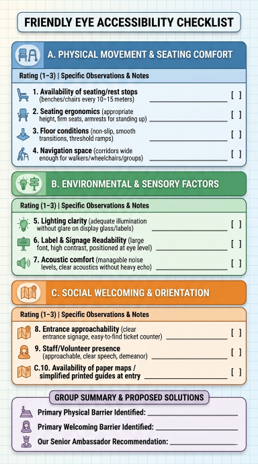
Needed equipment and materials: Printed "Friendly Eye Accessibility Checklist" (simplified format), clipboards, pens, and map layouts of the local cultural venue.
|
Step-by-step description: Stage 1: Preparation Detailed Facilitator Instructions):
Stage 2: Implementation ● Step 1:(The Walkthrough- 15 mins): Groups walk through their assigned zone acting as first-time senior visitors. Using Section A & B of the checklist, they evaluate seating frequency, floor surfaces, lighting contrast, and spatial layout.
● Step 2: (The Welcoming Check- 10 mins):Groups evaluate the "social comfort" of their zone using Section C of the checklist, noting whether signage is legible at eye level, if information points feel approachable, and if staff/volunteer presence feels welcoming.
● Step 3: (The Peer-Led Solution-15 mins): Groups gather at a designated seated area to review their findings. On the venue map, they mark ideal rest stops, identify high-friction zones, and formulate 2–3 concrete recommendations.
Stage 3: Feedback collection(10 mins): The groups gather again for a collaborative review session. Each group shares 2 physical observations and 1 social welcoming observation. The facilitator collects these findings into a unified Senior-Friendly Recommendation Sheet to be shared with museum management. |
Tips and adaptations: For Mobility Variations: Assign participants who prefer not to walk long distances to evaluate fixed, high-impact zones (e.g., the reception desk, entry hallway, or cafeteria/resting areas) where observation can be conducted primarily from a seated position. For Low-Vision/Sensory Considerations: Pair participants so that one reads/writes while the other observes and tests physical seating or signage contrast. Non-Intrusive Evaluation: Advise participants to conduct assessments quietly and respectfully without disrupting other museum visitors or staff operations.
|
Supporting Material : "Friendly Eye Accessibility Checklist" (Printable Tool)Instructions for Senior Cultural Ambassadors: Walk through your assigned venue zone and rate each item using the scale below. Use the notes section to add specific observations.Rating Scale: 1 = Needs Significant Improvement | 2 = Acceptable / Moderate | 3 = Excellent / Senior-Friendly |
Activity 2:"The Tech Companion" (Peer-to-Peer Audio Guide & QR Exploration) |
Learning Objectives:
|
Learning Outcomes: Knowledge: Understanding basic digital tools used in cultural settings and recognizing common usability barriers for older users. Skills: Collaborative peer-learning facilitation, active empathy, and basic technical navigation. |
Duration: 45 minutes |
Type : Pair activity (Groups of 2: one acting as the "Cultural Ambassador/Companion", one as the "Hesitant Visitor", then swapping roles) |
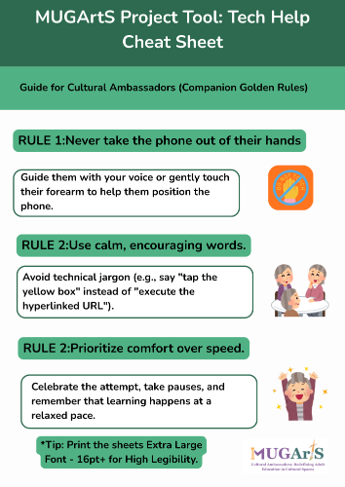
Needed equipment and materials: Smartphones or tablets, pre-prepared oversized printed QR codes linked to simple cultural stories or images, and a simplified "Tech Help" cheat sheet printed in large font. |
Step-by-step description: Stage 1: Preparation (Detailed Facilitator Instructions)
Stage 2: Implementation ● Step 1 (The Role Setup & Orientation - 5 mins): Form pairs. Partner A takes the role of the "Hesitant Visitor" (who feels anxious about using a phone for art exploration). Partner B takes the role of the "Tech Companion Ambassador."
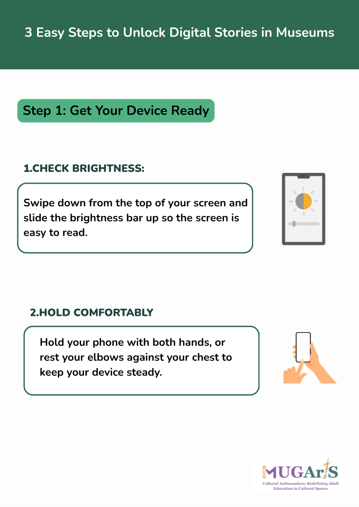
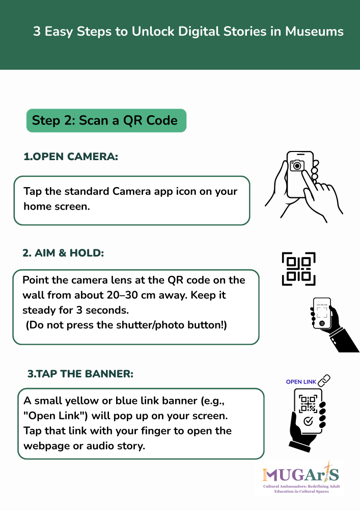
● Step 2 (The Guided Discovery- 10 mins): Partner B uses the Tech Help Cheat Sheet and supportive verbal cues to guide Partner A in opening their phone camera, scanning an oversized QR code on the wall, and launching the cultural story/audio track. The focus is strictly on patience, encouragement, and physical comfort (e.g., holding the device steady together).
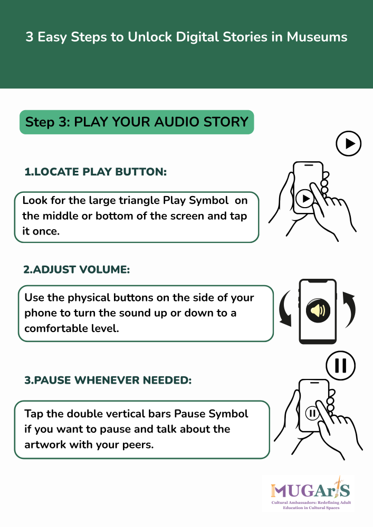
● Step 3 (The Role Swap- 10 mins): Partners swap roles using a different QR code around the room or testing secondary features (e.g., adjusting display font size, pausing/resuming audio, or adjusting volume).
Stage 3: Feedback collection (10 mins): ● The facilitator brings the group back together to reflect on the experience. ● Key Discussion Questions: What specific words or physical postures made you feel supported rather than rushed? What digital steps caused the most confusion, and how did your companion help you overcome them?
|
Tips and adaptations: For Varying Levels of Tech Proficiency: Pair a participant with higher digital confidence with one who has limited experience. For Physical Challenges (Shaky Hands / Limited Dexterity): Demonstrate how to rest elbows against the body or support the wrist when holding a device up to scan a QR code. Display Settings Adjustments: Before starting Step 1, spend 2 minutes showing all participants how to increase display font sizes and screen brightness on their Android or iOS devices.
|
Supporting Material : "Tech Help Cheat Sheet" (Printable Participant & Facilitation Guide) |
Activity 3: "Narrative Bridges":Intercultural Story-Mapping for Senior Inclusion |
Learning Objectives:
|
Learning Outcomes:
|
Duration: 50 minutes |
Type : Group activity (4–5 seniors per group, ideally blending different backgrounds or age ranges where possible)
|
Needed equipment and materials: Visual art reproductions (with no text), multi-language emotional keyword cards (simple words like Home, Hope, Family, Joy translated into major community languages and those of displaced population), post-it notes, and simplified visual storytelling templates.
|
Step-by-step description: Stage 1: Preparation: Facilitators introduce the sub-topic content on reducing intercultural barriers and utilizing basic, universal language structures.
Stage 2: Implementation ● Step 1 (The Visual Spark): Each group selects a single, highly expressive artwork or object illustration that does not require historical or technical background knowledge.
● Step 2 (The Key-Word Connection): Participants use multi-language keyword cards to associate personal feelings or memories with the object, minimizing dense text obstacles.
● Step 3 (The Shared Narrative): Seniors take turns passing a symbolic "storyteller token," sharing a brief 2-minute personal reflection or life perspective inspired by the piece, practicing simplified phrasing.
Stage 3: Feedback collection: Participants review how effectively the simplified, card-assisted narrative approach allowed everyone to participate equally, regardless of language proficiency or cultural background.
|
Tips and adaptations: Specific instructions on using purely visual communication signs or pantomime cues for senior groups facing profound language barriers. |
The journey to transforming museums and galleries into genuinely inclusive spaces relies on moving from passive hospitality to intentional, active co-creation. For senior citizens, true cultural accessibility is achieved when physical, digital, and linguistic barriers are removed in favor of supportive, face-to-face community environments. By empowering seniors to step into the role of Cultural Ambassadors, cultural institutions don't just open their doors, they activate lived experiences, connect generations, and shape traditional exhibition spaces into vibrant cultural spaces for non-formal adult education, community participation and mutual connection.
Real Life over Complex Curation: Senior visitors engage deepest when cultural dialogue emphasizes the human stories, relatable experiences, and historical context behind objects rather than complex, abstract curation.
The Physical Environment as the Essential First Step: : True accessibility requires arranging a welcoming space, such as strategically placed seating, rest breaks, and unobstructed walking paths before any shared learning or social experiences can begin.
The Value of Peer-to-Peer Digital Learning: Overcoming digital hurdles (e.g., QR codes, audio guides, tablets) is achieved most effectively through supportive, side-by-side companion learning, entirely avoiding individual or self-paced online tutorials.
Inclusivity Across Cultures and Backgrounds: Cultural inclusion requires the consistent use of plain language, clear graphics and signs, and tailored translations to ensure that displaced seniors and non-native language speakers feel sincerely welcome.
Becoming an Active Voice in the Community: Becoming a Cultural Ambassador is highly successful when organized around welcoming social invitations and event sharing, allowing seniors to organically build their comfort in guiding others within their personal social circles.
● Cultural Ambassador: An active senior (55+) trained to act as a community leader and peer advisor, helping other older adults access, navigate, and enjoy cultural spaces.
● Non-Formal Adult Education: Organized, flexible educational activities taking place outside the traditional formal schooling system, prioritizing life experiences, practical skills, and lifelong learning.
● Accessibility (Physical, Digital, Linguistic): The strategic removal of barriers to ensure all individuals, regardless of their physical mobility, experience with technology, or native language, can fully participate in cultural life.
● Connecting Generations Through Learning: A collaborative process where individuals from different age groups come together to share skills, perspectives, and life stories, building mutual respect and community connection.
● Plain Language (Simplified Wording): A clear, direct style of communication that avoids academic and technical terminology and complex sentence structures to make information easily comprehensible for diverse or displaced groups.
● Co-Creation: An inclusive planning approach where target groups (such as senior learners) actively collaborate with educators and cultural institutions to shape the content and structure of activities.
Part A: Bibliography
Academic Journal (Communication Barriers): Which Are the Needs of People with Learning Disorders for Inclusive Museums? Design of OLOS®. (Published in Applied Sciences, 2024).
Establishes methods for simplifying visual texts
Link: MDPI Applied Sciences Publication
Academic Journal (Senior Accessibility): Museums' accessibility for senior citizens: Some evidence from Italy. (Published in European Journal of Tourism Research, 2022).
Validates face-to-face staff training models.
Link: European Journal of Tourism Research
EU Policy (Adult Learning): Council Resolution on a new European agenda for adult learning 2021-2030. (European Council, 2021).
Outlines frameworks for social inclusion.
Link: EUR-Lex Resolution Framework
Academic Journal (Inclusive Design): Museums for Older Adults and Mobility-Impaired People: Applying Inclusive Design Principles and Digital Storytelling Guidelines:A Review. (Published in Heritage, MDPI, 2024).
Evaluates inclusive design and digital storytelling for senior visitors.
Link: MDPI Heritage Publication
EU Policy (Active Ageing): Policy Seminar on Ageing: Ageing in the Digital Era. (United Nations Economic Commission for Europe - UNECE, 2021).
Supports policy frameworks for older adults' digital inclusion and active ageing.
Link: UNECE Policy Seminar Report
EU Briefing Paper (Cultural Accessibility): Access to cultural life for people with disabilities. (European Parliamentary Research Service - EPRS, 2019).
Analyzes policies and physical/cognitive barriers affecting cultural participation.
Academic Journal (Social Inclusion): Loneliness, Protective/Risk Factors, and Coping Strategies Among Older Adults. (Published in Social Sciences, MDPI, 2025).
Examines coping mechanisms and social factors influencing senior loneliness.
Link: MDPI Social Sciences Publication
EU Policy (Demographic Change): Commission sets out tools to manage demographic change in the EU. (European Commission Strategy Framework, 2023).
Outlines European tools and strategies for empowering active ageing.
Link: European Commission Strategy Framework
EU Policy (Language & Diversity): EU Multilingualism Policy: Promoting Language Diversity and Language Learning. (European Commission Framework, 2024/2025 Updates).
Presents language diversity frameworks for accessible transnational learning.
Link: European Commission Multilingualism Policy
EU Policy Benchmark (Cultural Participation): Culture statistics - cultural participation. (Published by Eurostat, 2022).
Provides benchmarks on cultural engagement across EU demographics.
Link: Eurostat Culture Statistics Document
Academic Journal (Intergenerational Learning): Sharing passions and lived experiences: Reflections on the Impact of an Intergenerational Digital Storytelling Program. (Published in Social Sciences, MDPI, 2023).
Fosters cross-generational dialogue and combats ageism through digital storytelling.
Link: MDPI Social Sciences Journal Publication
EU Policy (Social Inclusion): Strategy on Intergenerational Fairness. (European Commission, 2026).
Promotes equitable opportunities and social cohesion across age groups.
Link: European Commission Intergenerational Fairness Strategy
Part B: Additional Resources for Senior Learners
● EPALE Article: "Adult Education in Greece: Policies and Practices"
o Language: English (Features an embedded, one-click automated translation menu into all official EU languages).
o Explores how Greek municipal Lifelong Learning Centres (K.D.B.M.) tailor non-formal education activities to active seniors (55+).
o Link: EPALE : Adult Education in Greece
● TimeSlips Creative Storytelling Implementation Kit
o Language: English
o A beginner-friendly digital guide containing exercises to help seniors lead loose, imagination-driven storytelling groups in community spaces.
o Link: TimeSlips Project Toolkit Website
● The MoMA Access Programs Portal ("Meet Me at MoMA")
o Language: English
o Provides practical strategies and video demonstrations for conducting low-pressure art appreciation sessions with older adults.
o Link: Museum of Modern Art Accessibility Page
● EPALE Resource Kit: Creativity and Culture for Social cohesion
o Language: English (Supported by full EPALE multilingual site translation into all official EU languages).
o Focuses on how cultural centers, museums, and community spaces can utilize non-formal learning, participatory arts, and heritage to foster active ageing, social inclusion, and group-based learning among older adults.